
UK Regulation
White-Label Casinos
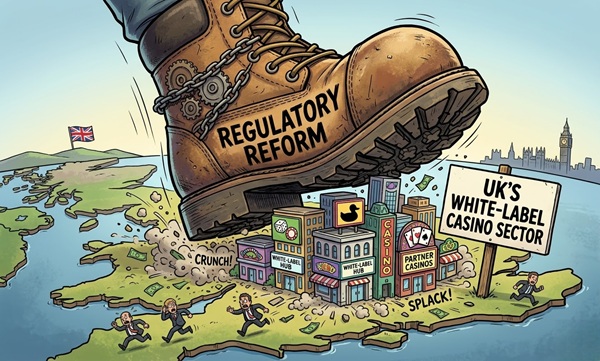
This still isn’t a dead model, and I wouldn’t pretend otherwise. But if you look at what’s happened over the past year, from football sponsorship scrutiny and enforcement action to tax pain, bonus reform and now the planned AG Communications retreat, it’s getting harder to argue that the UK white-label casino system remains a comfortable place to do business.
By Rob Hill| 24 March 2026
What’s happened
The latest news is a fresh industry argument over whether the government’s proposed crackdown on unlicensed gambling sponsorships in football could unsettle white-label arrangements. Some legal voices think a properly licensed white-label model should survive, because a UK-licensed entity is still the one taking the money and running the regulated side of the operation. Fair enough. But that’s a very narrow reading of a much wider-ranging problem.
That’s really the point. The white-label casino model isn’t under threat because of one consultation paper or one football sponsorship row. It’s under pressure because the whole atmosphere around low-commitment market entry, borrowed licences, third-party branding and offshore-facing relationships has become markedly less forgiving. If you’d asked me two or three years ago whether the UK would remain fertile ground for this sort of set-up, I’d have said yes without much hesitation. In March 2026, I’m no longer so sure.
The official government line is already revealing. Ministers announced on 23 February that they want to consult on blocking unlicensed operators from sponsoring British sports clubs, including Premier League sides, as part of a wider crackdown on the illegal market. That proposal is aimed at unlicensed firms rather than licensed white-label operators as such. Still, it tells you where the political wind is blowing. Westminster is no longer treating gambling sponsorship as a slightly grubby but tolerable commercial sideshow. It’s increasingly treating it as a consumer-protection issue with criminal and reputational overtones. That’s not an ideal climate for business models that depend on creative distance between brand, licence-holder and market reality.
My view
A white-label arrangement can still be lawful, regulated and commercially useful. But the era when it looked like an easy shortcut into the British market is ending. The UK now wants to know who is really behind a brand, where the money comes from, how the relationship is supervised, and whether anyone is quietly trying to enjoy the status of regulation without fully embracing the burden of it.
We’ve already seen what happens when that burden is not met. TGP Europe’s exit last May was the clearest warning shot. The Gambling Commission said its investigation into the company’s white-label model found failures around due diligence on ownership, source of funds and money-laundering risk. TGP was told it would have to pay a £3.3 million penalty and make significant improvements if it wanted to keep trading in Great Britain. Instead, it surrendered its licence and left. That mattered far beyond TGP itself. It showed that the regulator was perfectly willing to look past the branding and attack the operating structure underneath.
Once that happened, football clubs were dragged into the story too. The Commission warned several clubs that they were exposed if they promoted unlicensed gambling businesses, and its published guidance is now stark on the point. Sports organisations dealing with unlicensed operators risk committing the offence of advertising unlawful gambling, and officers can face prosecution in some circumstances. More to the point, the Commission says clubs must satisfy themselves about due diligence, effective blocking for Great Britain, and even the source of funds behind the arrangement. Again, that doesn’t outlaw white-labels. What it does do is make the whole area feel hotter, more supervised and less easily fobbed off with glossy branding and a licence number tucked in the footer.
Pressure point one
Sponsorship scrutiny. The government is openly looking at banning unlicensed sponsorship routes in sport, and the regulator has already signalled that clubs, officers and partners are expected to do proper due diligence.
Pressure point two
Compliance exposure. TGP Europe’s collapse as a UK white-label operator, and AG Communications’ own regulatory settlement, have made the risks look concrete rather than theoretical.
Pressure point three
Economics. If your model depends on aggressive acquisition, flexible bonuses and thin margins, the UK has become a much less forgiving place to run it.
That last point is where the economics really start to bite. Since 19 January, online operators have had to live with new bonus rules that cap wagering requirements at 10x and ban mixed-product promotions. Those changes weren’t written specifically to target white-label operators, but they land hardest on exactly the kind of acquisition-heavy brands that rely on promotions to stand out in a crowded market. Take away some of that promotional elasticity and you remove one of the easier ways a smaller or more generic label could buy attention.
Then comes tax. From 1 April 2026, Remote Gaming Duty jumps from 21% to 40%. That’s not a tweak. It is a proper financial shock, especially for remote casino businesses already operating in a highly competitive market. Bigger operators with stronger brands, proprietary systems and deeper pockets may absorb that blow more gracefully. A white-label operation living off borrowed infrastructure and middling brand loyalty may not. If your margins were already being squeezed by compliance costs and bonus reform, a near-doubling of remote gaming duty is the sort of thing that turns “challenging market conditions” into “activate the escape plan.”
Which brings me to AG Communications Limited. This is where the story stops being abstract. In January, iGB Affiliate reported that Aristocrat Interactive-owned Aspire Global had partially shut down UK casino operations, with several brands already defunct and more closures following. One day later, Aristocrat confirmed to iGBA that it would close its entire white-label operation by June 2026 and stop offering such services globally by 30 June. That is about as clear a market signal as you could ask for. When a major supplier looks at the UK and decides white-label is non-core, that says something important about the direction of travel.
It looks even worse when you remember AG Communications’ recent record. In March 2025, the Commission ordered it to pay just over £1.4 million after finding anti-money-laundering and social responsibility failures. The operator, trading as AspireGlobal, was said to run 58 websites at the time. Put all of that together, and the broader picture becomes hard to ignore. A major white-label licence-holder gets hit by enforcement action. The parent business starts shutting brands. The owner then confirms a full white-label exit. This is not a sign of a sector bubbling with confidence.
There’s another layer people are missing
Recent reporting-rule changes have made the UK more interested in who is really behind licensed operations. From 19 March 2026, the Gambling Commission’s updated key-event rules expand reporting around relevant persons, entities without share capital and relevant loans. That doesn’t kill white-labels by itself, but it does fit the same pattern. The system wants fewer shadows, fewer convenient blind spots, and a better view of who is funding and controlling what.
That matters because the old sales pitch for white-labels was always some version of simplicity. Faster entry. Lower friction. Shared compliance infrastructure. Ready-made payments, games and support. For some firms, that still has value. But simplicity for the entrant can mean complexity for the regulator, and the regulator has started pushing that complexity back where it belongs. If the UK now expects clearer accountability, more reporting, more due diligence and a stronger handle on who sits behind a licence, the borrowed-light model inevitably looks less charming.
I should be fair here. The iGaming Business piece that sparked this discussion is right to note that a targeted ban on unlicensed football sponsorships wouldn’t automatically wipe out lawful white-label partnerships. A properly licensed operator taking UK money in a compliant way is still a different proposition from a rogue offshore brand trying to sneak through the back door. So no, I’m not predicting an overnight extinction event. That would be melodramatic and lazy.
What I am saying is that the British market increasingly looks hostile to the sort of white-label arrangement that survives on ambiguity, soft oversight, promotional brute force and wafer-thin margins. The brands and suppliers best placed to survive will be the ones that can operate as though the borrowed licence is not an excuse to cut corners. Everyone else is now looking at a market with higher tax, tighter promotions, harsher scrutiny around sponsorship, more regulatory curiosity about ownership and funding, and recent examples of major white-label operators deciding to head for the door.
My conclusion
Yes, I think the UK white-label casino model could be at risk, not because one minister woke up and declared war on it, but because the ground under it has shifted. The compliance risks are clearer, the politics are rougher, the margins are thinner, and the biggest operators no longer seem convinced this is an easy way to stay in the British game. The model may survive in a leaner, more disciplined form. But the casual, low-conviction version of it looks increasingly like it’s done for.