
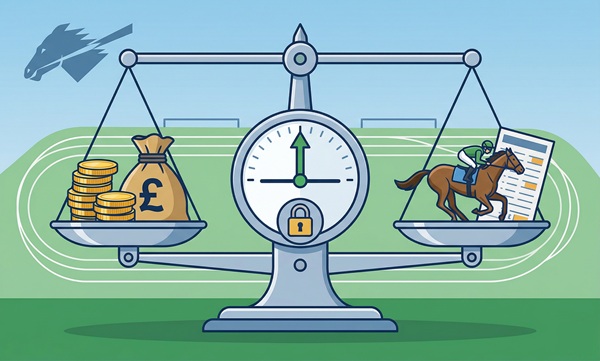
The government has finally concluded its long-running review of the Horserace Betting Levy and, after all that waiting, has decided to leave the rate exactly where it is. British racing is not pleased. I can understand why. I’m just not sure the sport can act as though this is some outrageous betrayal without also taking a hard look at itself.
The levy stays at 10%, and the government has also refused to extend it to overseas racing. The BHA says the sport has waited years for nothing and still gets too little back from betting. The disappointment is real and understandable, but some of the outrage feels selective and a touch convenient.The decision
Racing’s mood
My take
The basic news is simple enough. In a written ministerial statement, Baroness Twycross confirmed that the government will not change the Horserace Betting Levy after the conclusion of the 2024 review. Bookmakers with annual gross profits on British horseracing above the threshold will continue to pay the levy at 10%, and ministers have also said no to extending the levy to overseas racing. The official explanation is that, in light of recent gambling tax changes, the government wants to provide stability and certainty to the wider gambling sector. That is the clean, tidy Whitehall answer.
As ever, the tidy answer is only the start of the argument. Racing had spent a long time hoping that this review would finally produce something more generous. The sport’s leadership has been making the same case for ages: racing is expensive to stage, costly to regulate, and still uniquely tied to betting in a way that few other sports can claim. The feeling within the industry is that bookmakers continue to derive huge value from British racing while the return to the sport itself remains too thin. When the government finally came back after all that delay and said, in effect, “thanks very much, but no”, it was never going to be received well.
Why racing is angry
From racing’s point of view, this review took far too long, solved nothing, and left the sport still arguing that it bears the cost of putting on the product while betting businesses continue to profit from it at a rate the sport considers excessive.
Brant Dunshea at the BHA didn’t try to hide his irritation. He said it was disappointing that it had taken almost three years to arrive at no change, and argued that racing had provided clear evidence of a growing gap between the cost of providing the sport and the return it receives from betting. He also pointed to a line from DCMS pre-Budget advice suggesting that, unless racing’s carve-out on gambling duty was matched by an increase in the levy, the sport would be unlikely to feel any benefit. That isn’t a trivial complaint. If racing was effectively told, or at least strongly encouraged to believe, that there was logic in pairing tax protection with levy reform, then it is not unreasonable for it to feel short-changed now.
There is also a comparative argument which racing loves making, and not without reason. The BHA says British racing receives less than 3% back from gambling, while the comparable figures in France and Ireland are materially higher. Whether you like these cross-border comparisons or not, they do make a simple point. British racing believes it’s under-monetised in its relationship with betting, and it has believed that for some time. The refusal to extend the levy to overseas racing only adds to that irritation, because the sport sees this as another example of the system failing to match the modern betting landscape.
On the narrow question of disappointment, I think racing is entitled to feel that way. It waited a long time. It clearly expected some movement. It can point to the burden of staging and maintaining the sport. And it can fairly say that the government has now closed the file without offering a new funding answer. If your question is simply, “Are they allowed to be annoyed?”, then the answer is obviously yes.
Where I sympathise
The review dragged on, the final answer was a flat no, and racing can plausibly argue that its cost base and its betting return remain badly out of sync.
Where I get sceptical
The sport too often talks as though government reluctance is the whole problem, when internal division, governance rows and commercial weakness are plainly part of the picture too.
Where government has a case
Ministers can point to a record levy yield, a racing carve-out from the new remote betting rate, and a desire not to pile fresh upheaval onto the sector during wider tax changes.
Because here is the other side of it. The government is not leaving racing with nothing. Last year’s levy yield reached £108 million, which was above the previous year’s £105 million. Meanwhile, when the Treasury set out its new tax treatment for remote gambling, it explicitly protected UK horseracing bets from the new 25% remote betting rate arriving in 2027. Remote horseracing bets will stay taxed at 15% because operators already face the 10% statutory levy on those bets, which ministers say leaves the effective burden in line with the new remote betting position anyway. In other words, government didn’t look at racing and decide to clobber it. It actually preserved a special position for the sport within the wider tax framework.
That doesn’t settle the argument, but it does make the industry’s more theatrical outrage a bit harder to swallow whole. Racing sometimes speaks as though every setback is proof that ministers don’t understand the sport or don’t care about it. I’m not convinced that’s the fairest reading here. Twycross’s statement was hardly anti-racing. It went out of its way to praise British racing as a national treasure, noted that attendances increased in 2025, and urged the sport to improve governance, modernise the fixture list and work more collaboratively with betting. You may think that sounds patronising, and perhaps it does a bit, but it’s not the language of a government trying to leave racing out in the cold.
The sharper question is whether racing has quite earned the right to sound this aggrieved. I say that because the sport has been in visible internal disarray of its own. Only this month, the resignation of Charles Allen as BHA chair after just six months exposed a messy governance row, with major racecourses effectively lining up against smaller tracks and calling for structural reform. That doesn’t mean the levy issue is a smokescreen. It does, however, mean racing cannot plausibly present itself as a perfectly unified, commercially streamlined victim of outside neglect. Some of the sport’s troubles are home-grown, and everybody in the game knows it.
This is the part racing never likes hearing
Government policy matters, of course it does. But British racing also has a habit of blaming ministers, regulators and betting firms for problems that are partly rooted in its own governance, fragmentation and inability to speak with one convincing commercial voice.
I don’t say that to let government off the hook. There is a real argument that Whitehall has played this badly. Letting the review drag on for so long only to land on continuity was a surefire way to maximise irritation. If ministers always knew they were unlikely to move, they could have communicated more honestly and more quickly. And if the department really did recognise, before the Budget, that a racing carve-out without levy reform would leave the sport feeling little benefit, then it’s fair to ask what changed beyond political convenience.
Even so, I keep coming back to the same conclusion. Racing is entitled to disappointment, but not quite to self-righteousness. The government has kept the levy unchanged, yes. It has also maintained racing’s tax carve-out and left the sport with a levy that remains substantial in cash terms. If the industry wants to argue that the model is still inadequate, that’s a legitimate case to make. If it wants to suggest ministers have dealt it some uniquely cruel blow while the sport itself is otherwise healthy and well-governed, I think that’s much harder to defend as a standpoint.
There is also a gambler’s-eye view of all this that shouldn’t be ignored. Horse racing often talks about betting as though the relationship ought to be endlessly deepened because the sport depends on it. Fine. But punters are already dealing with affordability friction, tougher account scrutiny, and a wider sense that betting is becoming more awkward, less enjoyable and more tightly supervised. From that perspective, there are limits to how much sympathy the sport can expect when it asks for a bigger automatic slice of betting revenue. That argument may play well within racing, but outside it, especially among ordinary bettors, it’s not always going to sound noble.
My verdict
British racing is absolutely entitled to be disappointed by this decision. The process dragged, expectations were raised, and the final answer offered no new financial relief. But disappointment is not the same thing as complete vindication. Government has preserved racing’s special tax position and can point to a healthy levy yield. Meanwhile, the sport still has obvious governance and commercial problems of its own. So yes, racing has every right to feel fed up. What it does not quite have is the right to act as though ministers alone are responsible for everything that now feels difficult about its future.