
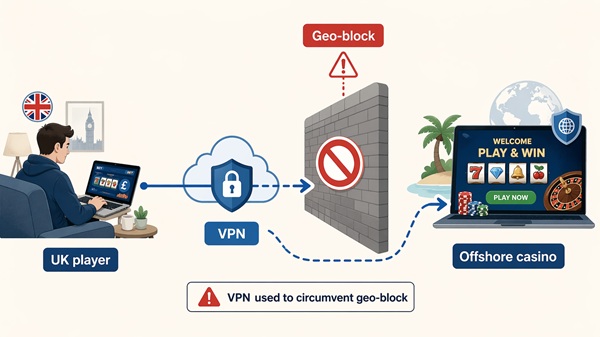
This is a growing concern, and I can see why. If you’re the UK regulator trying to work out how big the illegal gambling market really is, and how effective your disruption work is, VPNs are a nuisance from several directions at once. They hide traffic, muddy the data, weaken geo-blocking, and make it harder to tell whether a drop in visible activity is a real decline or just a detour through another country’s IP address.
The news in a nutshell is that the Gambling Commission is increasingly concerned about the role VPNs may be playing in facilitating access to illegal gambling and about the regulator’s ability to measure what is really going on. That concern doesn’t strike me as overblown. It strikes me as overdue. The black market has never relied on one single route into the wallets of the UK’s gamblers, and the regulator’s own updates have made clear that web traffic data can show trends without ever giving a clear headcount. Once VPNs become part of that picture, the map becomes very blurred. Getting accurate statistics becomes almost impossible because VPNs, by their very nature, are designed to hide their users.
The Commission has been fairly careful in how it describes the problem. It hasn’t simply said that illegal gambling is exploding and nobody can see the full picture anymore. In fact, its recent updates have stressed that the overall trend line doesn’t show a sustained rise in engagement with illegal sites. What it is saying is subtler than that. It’s saying the data has limits, those limits matter, and VPN use is one reason the black market may be harder to track than the visible numbers suggest.
To me, that’s a sensible concern. If a regulator is relying partly on traffic estimates, disruption outcomes, geo-blocking and search removals, then anything that weakens the visibility of user behaviour is a real problem. A VPN doesn’t just help somebody hide where they are. It can also make enforcement wins look cleaner than they really are. If a site’s visible UK traffic drops after action is taken, that might mean the disruption worked. It might also mean some of the audience just came back through another route.
Why VPNs bother the regulator so much
There is also a broader cultural shift behind this. Gamblers are simply more aware of VPNs than they used to be. That matters beyond gambling. Once people get comfortable using a VPN for privacy, streaming, age-gated content or other restricted services, the technical hurdle falls away. At that point, using one to access an offshore casino is no longer some specialist trick for tech nerds in dark bedrooms. It becomes a fairly ordinary workaround for a person who’s already decided they want to get round the UK’s protective systems.
And that is where I think the debate gets interesting. The real problem here is not the software itself. A VPN is not automatically dodgy. Plenty of people use one for work, general security or simple privacy. The real problem is the combination of intent and access. If a user is actively trying to reach a site that’s off-limits to British customers and the VPN helps them do so, then the VPN becomes part of a black market journey. It’s not the whole journey, but it’s one of the key roads – a literal bypass, if you will.
There is a certain sort of online casino fan that treats offshore access as a clever little loophole. A way of dodging friction. A way of escaping checks. A way of getting the old, looser gambling experience back. I’ve never found that prospect remotely persuasive. If a site isn’t licensed for Great Britain, it’s not safe for UK players. More importantly, the practical protections are weaker. If there’s a withheld withdrawal, a badly handled KYC row, a disappearing balance, or a complaints mess, you’re not standing on the same ground you would be with a properly licensed British operator.
This is bigger than VPNs
That’s the point I keep coming back to. VPNs matter, but the black market still needs discovery routes. People don’t usually wake up one morning, switch on a VPN, and automatically know which illegal casino to trust. They still find these brands through search results, affiliate pages, social media, tip-offs, forums and recommendation culture. The VPN is often the last leg of the journey, not the first.
That is why I would be wary of any framing that turns this into a single-issue tech story. The UKGC’s own work already points to a wider ecosystem involving search engines, advertisers, hosts, registrars and payment channels. Illegal gambling is not just a matter of hidden traffic. It’s a matter of discoverability, convenience and motivation. The VPN can help a determined user get through the door, but somebody still has to show them the address in the first place.
This is also why I think the regulator’s concern is justified without being evidence of panic. The Commission isn’t saying it has lost control of the whole picture. What it is saying is that the picture is harder to read cleanly than some commentators pretend. That strikes me as a mature position. Illegal gambling is one of those subjects where everyone wants a clear number and a solid conclusion. Realistically, the truth is harder to pin down. The black market is part hidden, part shifting and part deliberately evasive. A regulator that admits that is being more trustworthy, not less.
There is another awkward truth here as well. For some users, VPN use is not just about privacy. It’s about resistance. It’s about wanting to get around checks, exclusions, stake limits, source-of-funds friction or product restrictions. Once that becomes the mindset, the problem is no longer only technical. It becomes behavioural. A person who wants to route around the licensed market will not be stopped by one blocked URL or one removed search result. That’s why the fight against illegal gambling can’t be won on web traffic disruption alone. It has to involve payments, platform cooperation, clearer public messaging and, frankly, a more honest conversation about why some users are looking for the exit in the first place.
My view
The UKGC is right to be worried about VPN use.
But it would be a mistake to treat VPNs as the disease.
They’re closer to a symptom and an enabler inside a wider black-market system that has become more deliberate, more normalised and a bit more technically confident.
If I’m being blunt, that wider system is the real story. The black market isn’t held together by one app, one technology or one trick. It survives because enough users can still find it, reach it and persuade themselves it’s worth the risk. VPNs help with the second part. They don’t explain the whole thing. And that’s why I think the regulator’s concern should be read as part of a bigger warning, not as an obsession with a single privacy tool.
If the UKGC is worried about VPN use, I think it should be. But the real lesson is not that VPNs are uniquely sinister. It’s that Britain’s illegal gambling problem is getting more slippery, more layered and more technically awkward to track. The regulator’s disruption work still matters, and by its own account, it is having an effect. It just isn’t fighting on a clearly defined battlefield anymore, and pretending otherwise would be the bigger mistake.