
Is Your Casino Lobby Nudging You Towards the Wrong Games?
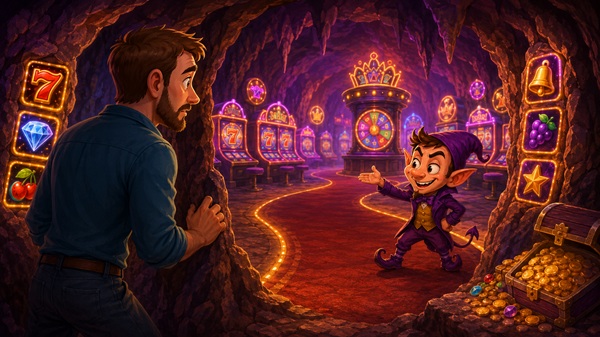
A casino lobby looks like a menu. That’s the trick. It feels as if you’re simply choosing from a shelf of games, when in reality the shelf has already been arranged for you. The site has decided what you see first, what gets called “popular”, what gets pushed under your thumb on mobile, and what information you’ll probably never bother looking at before you play.
By Brian Taylor | 20 May 2026
Online casino lobbies are now the front door to a huge part of British gambling. Casino games generate billions in gross gambling yield, and slots account for most of that money. The first screen a player sees is not just decoration. It’s the shop window for one of the most profitable parts of the entire gambling sector.
I’m not saying every casino lobby is wicked, or that every game placement is a psychological trap. Some of it is ordinary retail behaviour. Supermarkets put things at eye level. Streaming services push new releases. Bookmakers highlight big football markets. Casinos, unsurprisingly, arrange their products too. The difference is that casino choices can cost real money very quickly, and the information needed to make a sensible choice is often tucked away behind an info button, a provider screen, or a help panel that the player may never open.
That’s where I think the lobby deserves more scrutiny. We’ve spent years talking about RTP, safer gambling tools, withdrawal problems, bonus terms and whether slots now feel colder than they used to. All of that matters. But before a player even reaches a game, the lobby has already shaped the path. It’s made some games feel obvious and others invisible. It’s turned a few thumbnails into the natural next click.
Where the nudge happens
The mobile point is the big one for me. A desktop casino lobby can feel sprawling. You can see rows, menus, provider lists and search tools at once. On a phone, everything narrows into a vertical tunnel. You see what the site wants you to see first. Then you swipe. Then you swipe again. That may sound trivial, but most online gambling now happens in short bursts of attention. If the first visible strip of games is doing the selling, the rest of the lobby is already playing catch-up.
This is not just a design issue. It’s a disclosure issue. Imagine two slots with similar artwork and the same headline RTP, but one has a brutal volatility profile and the other gives a steadier ride. Many players would choose differently if that difference was shown plainly. Instead, casino lobbies often rely on big thumbnails, familiar brand names and vague categories. The information that would actually help a player understand the character of the game is either absent or buried.
RTP is a good example. UK-facing games have to make important information available, and licensed operators sit under technical standards that govern game fairness, information and player protection. But “available” is not the same as “useful at the moment of choice”. If I need to open a game, click a tiny information icon, read a provider help file, then compare that with another game manually, the lobby hasn’t really helped me compare anything. It’s technically made information available while practically encouraging me to choose by vibe.
The information players actually need
A player-friendly lobby wouldn’t need to turn every slot thumbnail into a spreadsheet. But it could show enough to stop people choosing blindly.
I’m especially suspicious of the word “popular”. Popular with whom? New players? Existing players? Bonus hunters? High-stakers? People playing for ten minutes on payday? Games with the most launches this week? Games that produce the most revenue? Games the casino has decided to promote? A category can be true and still be unhelpful. “Popular” may simply mean a lot of people are being nudged into the same thing.
There’s a loop here. A game is placed prominently because it’s popular. It gets more clicks because it’s placed there. It remains popular because it gets more clicks. That doesn’t make it bad. Some games become popular because they’re genuinely good. But from the player’s point of view, the loop is worth noticing. If the lobby keeps putting the same slot in front of you, it can start to feel like a recommendation when it may simply be the result of commercial inevitability.
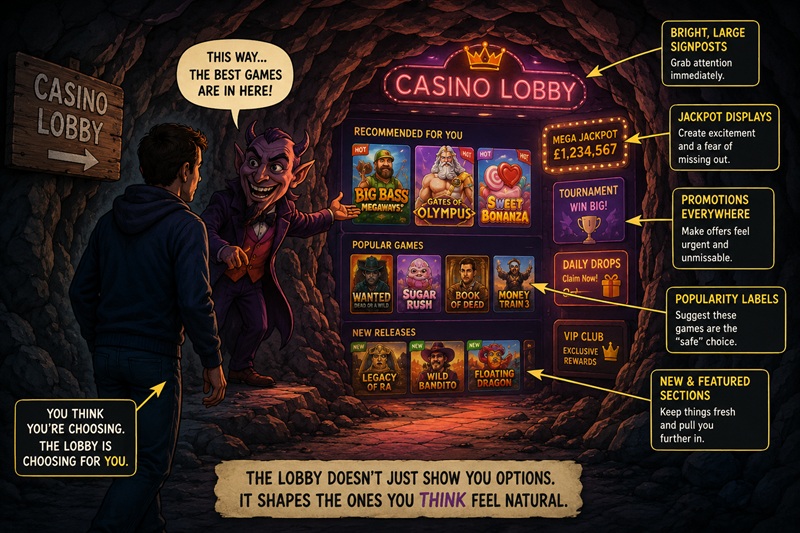
The same goes for “recommended for you”. That phrase carries a lot of borrowed trust from streaming, shopping and music apps. It suggests personal relevance. In a casino, I’d treat it with more caution. A recommendation may be based on what you’ve played before, what similar users played, what’s new, what’s commercially important, or what the site is testing. Without an explanation, the player is left guessing whether the recommendation is serving them, the operator, or both.
The casino lobby test I use
- What games does the casino show me before I scroll?
- Can I see RTP before launching the game?
- Can I see volatility or risk style without opening separate rules?
- Are jackpot, live casino or high-intensity games pushed harder than quieter options?
- Does search help me find what I want, or mostly return what the casino wants to show?
- Can I hide, filter or avoid game types that don’t suit me?
That last point is underused. A really good UK casino lobby would not only help me find games I like. It would help me avoid games I know are a bad fit. If I don’t want high-volatility slots, jackpot chases or certain live game formats, the lobby should make that easy. The industry talks a lot about personalisation, but personalisation often seems to mean “here is more of what might keep you playing”, not “here is a way to stay within the kind of gambling you intended to do”.
This is where product design starts to overlap with safer gambling. I don’t think every casino lobby needs to look like a public health notice. Nobody wants to open a casino site and feel as if they’ve walked into a dentist’s waiting room. But a lobby can be enjoyable and still more honest. It can sell games without hiding the character of those games. It can promote new releases while giving players enough detail to understand what they’re picking.
The comparison with streaming services is useful but limited. If Netflix nudges me towards a bad film, I waste two hours and become mildly irritated. If a casino nudges me towards a game with a risk profile I don’t understand, I can lose money in a way I didn’t intend. That changes the duty of care, at least morally. Gambling operators should not be allowed to act as if game discovery is merely a matter of entertainment taste.
My view
A casino lobby is not neutral. It’s a curated space. That doesn’t automatically make it unfair, but it does mean players should stop treating the first few rows as if they arrived there by accident. The site has made choices before you make yours.
There is a commercial reason lobbies look the way they do. Operators have supplier relationships, launch schedules, exclusive deals, jackpot campaigns, bonus promotions and internal revenue goals. Some games will be more valuable to push than others. Some products will be better at holding attention. Some rows will be built around the site’s own priorities rather than the player’s. Again, that’s not shocking. It’s just business. But gambling is not an ordinary shop, and the player deserves to know when the shop window is doing more than displaying stock.
I also think this is where regulators may eventually have to look more closely. The UK has already intervened in the design of games themselves: spin speed, autoplay, losses disguised as wins, feature buy-ins, stake limits and other mechanics have all attracted attention. The next question is whether the pre-game environment deserves the same sort of thinking. If the lobby is where product risk, commercial pressure and player decision-making meet, it’s hard to see why it should remain a design free-for-all.
That doesn’t mean banning “popular games” rows or forcing every thumbnail to carry a warning label. I don’t want nonsense regulation. But I do think a sensible casino lobby should make key game information visible earlier, especially on mobile. It should make searching and filtering genuinely useful. It should avoid dressing commercial promotion as player guidance. And it shouldn’t make the riskiest or most intense products feel like the default route just because they’re profitable.
Players can do something practical as well. Start treating the lobby as advertising, not navigation. Before you click the first game on the page, ask why it’s there. Is it genuinely what you came to play, or has the lobby simply made it the easiest option? Check the game info. Check RTP where available. Learn the volatility language. Use provider filters if you trust certain studios. Search directly when you know what you want. The more deliberate the first click is, the less power the lobby has over the session.
I would also be wary of lobbies that feel cluttered by design. Too many carousels, too many badges, too many “hot” labels, too many pop-ups and too many near-identical thumbnails can exhaust choice rather than improve it. When a lobby overwhelms you, the easiest thing is to click whatever’s brightest or nearest. That may be exactly what the design is counting on.
So, is your casino lobby nudging you towards the wrong games? Possibly. More precisely, it’s nudging you towards certain games and not always giving you the information you need to decide whether those games are right for you. That’s the distinction. The lobby may not be lying. It may not be breaking rules. It may simply be doing what modern digital interfaces do: arranging choice in a way that feels natural while subtly steering behaviour.
My final answer is this: casino lobbies deserve more scepticism than they get. They’re not just shelves. They’re sales funnels with thumbnails. A good one can help players find enjoyable games quickly. A bad one can push riskier, flashier or less suitable games while hiding the details that would help a player choose more carefully. If UK casinos want to be taken seriously on transparency, the lobby is a good place to prove it.