
Research Article | UK Gambling | Illegal Market
Are Black Market Casinos on the Rise in the UK?

The short answer is yes, probably, but not in the tidy, easily measured way campaign groups and industry bodies sometimes imply. The illegal market is plainly a real issue in Britain. The harder argument is about scale, speed, and which numbers deserve the most confidence.
By Rob Hill
UKGC traffic study
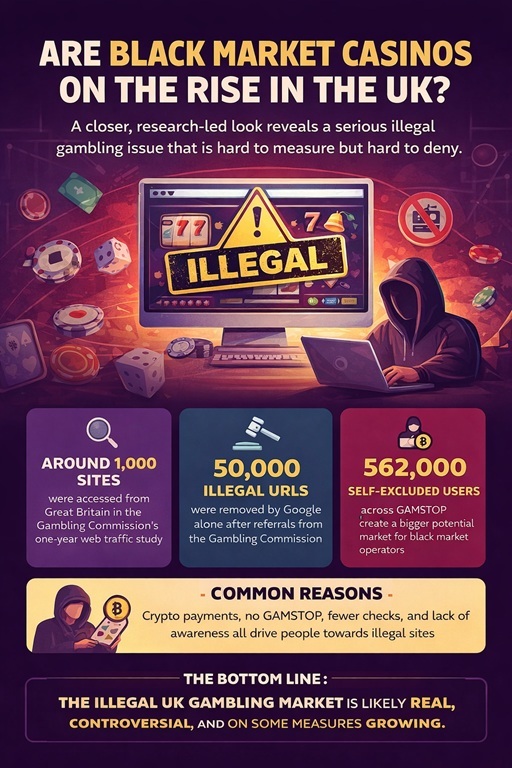
About 1,000
unique illegal gambling sites were accessed from Great Britain between May 2024 and July 2025, according to the Gambling Commission’s Illegal online gambling: Consumer engagement and trends report.
Important caveat
No overall rise
in total engagement was found across that same period by the Gambling Commission, although it did record spikes in summer and autumn 2024.
Enforcement activity
50,000
illegal URLs were removed by Google after referrals from the Gambling Commission, according to the Commission’s cease and desist figures.
The black market debate in British gambling has become one of those arguments where everybody seems to arrive carrying a different calculator. Licensed operators and lobbying groups tend to present the illegal sector as a rapidly swelling threat, fuelled by heavier regulation and a more frustrated customer base. The regulator’s own work paints a slightly more awkward picture. It doesn’t deny the problem – far from it – but it’s more careful about claiming a dramatic nationwide surge before the evidence fully supports it.
That distinction matters. There is clearly an illegal online gambling ecosystem targeting British users. There are sites that operate without a UK Gambling Commission licence, sites openly advertising themselves as routes around GAMSTOP, and sites pushed through social media, forums, and search results in ways that blur the line between visibility and legitimacy. But a market being real is not quite the same as a market being easy to count. The Gambling Commission has been quite open about that.
The serious question is not whether the black market exists. It plainly does. The real question is whether it is rising across the board, or growing in specific corners that standard headlines flatten into one big story.
What the official research actually says
The best starting point is the UK Gambling Commission’s own research, because it’s the most direct attempt so far to measure how British consumers engage with illegal websites. In its September 2025 report Illegal online gambling: Consumer engagement and trends, the Commission said roughly 1,000 unique illegal gambling domains were accessed from Great Britain between May 2024 and July 2025. That sounds significant, and it is. But the same report also said there was no overall increase in engagement across the full period once total traffic and visit duration were analysed. The trend line moved around, with peaks in summer and autumn 2024, then eased back again. That’s a more restrained conclusion than some campaign narratives allow for.
In other words, the regulator isn’t saying, “there is no problem.” It’s saying, “yes, there is a problem, but the data doesn’t yet justify every dramatic claim made about runaway growth.” That’s a useful distinction, because hidden markets are notoriously hard to measure. A traffic spike is not always the same thing as sustained growth, and a loud estimate is not automatically a better one.
How players actually end up on these sites
One of the more revealing official studies is the Commission’s Phase 1 Consumer Voice work, published in September 2025 as Exploring consumer pathways into using illegal gambling websites. That report found something that should worry anyone who thinks this is only about rogue thrill-seekers hunting for forbidden sites. Some users didn’t even realise the websites they had used were illegal. They assumed that a professional-looking site, a familiar payment method, or a recommendation from somebody online meant the operator was legitimate.
The same study also offered some useful numbers on how people are drawn in. Word of mouth featured in 33% of pathways identified in the survey work. Social media personalities were cited in 29%, and gambling forums in another 29%. These aren’t small details. They tell us that discovery often happens through trust networks rather than through a player deliberately setting out to break the rules. Once people hear that a site pays quickly, accepts crypto, skips certain checks, or is “not on GAMSTOP”, the social proof can do the rest.
The motivations are predictable enough. Some users are looking for games or betting markets unavailable on licensed British sites. Some want looser onboarding. Some want cryptocurrency. Some have self-excluded and are actively searching for a way around that barrier. None of that makes the black market respectable, but it does explain why it keeps finding oxygen.
Why GAMSTOP matters to this conversation
We have to talk about self-exclusion, because it sits right in the middle of the modern black market debate. GAMSTOP’s own 2025 H1 data showed registrations up 19% year on year, with registrations among 16 to 24-year-olds up 44%. That same release said under-25s accounted for more than a quarter of new registrations, while short six-month exclusions were becoming more common among younger users.
That doesn’t prove that everyone who self-excludes ends up looking for illegal sites. It would be absurd to claim that. But it does tell us there is a growing pool of people who are shut out of the regulated market and therefore vulnerable to marketing built around phrases like “not on GAMSTOP” or “no UK restrictions”. In practical terms, that creates an opportunity for illegal operators, whether or not every self-excluded user takes it.
A point that often gets missed
Growth in the self-excluded population is not proof of black market growth by itself. What it does show is that a larger number of British consumers now have a practical reason to notice offshore sites claiming to ignore British safeguards.
The larger market-size claims
This is where things get messy. The Commission’s position has been careful to the point of understatement. In its November 2025 paper on the challenges of estimating the size of the illegal market, it said it was’t yet ready to publish a confident overall estimate of the sector’s size in spend or gross gambling yield terms. That’s the regulator admitting that the evidence base, while improving, still has holes in it.
Outside the regulator, the tone becomes far bolder. Industry-backed or campaign-linked estimates have suggested a much larger hidden market. Reporting in the British press, including The Guardian, has highlighted claims based on Yield Sec analysis that illegal operators took £379 million in the first half of 2025 and may now account for around 9% of the online gambling market, up sharply from earlier years. Those figures may point to a genuine worsening trend, particularly in online sports and streaming-adjacent ecosystems, but they aren’t the same thing as an official settled estimate. They should be treated as part of the evidence base, not the last word.
What nobody can seriously deny
Even if one brackets the biggest market-share claims, the enforcement picture alone shows this is no phantom issue. The Gambling Commission’s published cease and desist data said that, over the cited period, it had issued more than 750 cease and desist and disruption notices. That included 259 aimed at operators and 189 at advertisers. The same figures said more than 78,000 URLs had been referred to Google, with 50,000 removed, and 255 websites taken down. Those aren’t token numbers. They describe an enforcement effort dealing with something stubborn and active.
The regulator has also become more vocal about the role of major online platforms. In January 2026, Reuters reported comments from Gambling Commission executive Tim Miller accusing Meta of effectively allowing illegal gambling advertising to proliferate on its platforms, including ads for sites openly promoting themselves as outside GAMSTOP. If that accusation is even partly fair, then the black market isn’t just a niche website problem. It’s also an advertising and platform-governance problem.
So, are black market casinos on the rise?
The most honest answer is yes, in some respects, but the evidence is uneven and sometimes politicised. There is clear evidence of substantial illegal activity targeting British users. There is clear evidence of growing enforcement. There is clear evidence that some users arrive through social recommendation, search, and routes around self-exclusion. There is also evidence, from the regulator itself, that the overall engagement trend is not yet a simple straight line upwards.
That means the right conclusion is neither complacency nor panic. It’s possible to say, at the same time, that the black market is a genuine threat and that some of the louder headline numbers still deserve caution. In fact, that’s probably the most grown-up view of the situation.
Our view is that black market casinos are becoming more visible, more opportunistic, and more professionally marketed in the UK, especially around search, forums, social platforms, crypto-friendly users, and people trying to bypass safeguards. Whether that amounts to a universal explosion is less certain. But if the question is whether Britain has a black market casino problem that may be getting worse in specific channels, the answer is plainly yes.
Sources referenced in this article
UK Gambling Commission, Illegal online gambling: Consumer engagement and trends, September 2025.
UK Gambling Commission, Illegal online gambling, Phase 1: Exploring consumer pathways into using illegal gambling websites, September 2025.
UK Gambling Commission, Cease and Desist Notices enforcement figures.
GAMSTOP, Biannual Data 2025 H1.
UK Gambling Commission, Challenges of estimating the size of the illegal online gambling market, November 2025.
Reuters reporting on UK Gambling Commission comments regarding illegal gambling ads on major social platforms, January 2026.