
Slots
Myths and Maths
Can You Really Tell When a Slot Is About to Pay Out?

I’ve heard every version of this theory over the years. The slot has gone quiet for too long. The bonus is teasing. The reels are “warming up”. It’s throwing out near misses. It’s due. The trouble is that slot folklore sounds most convincing at exactly the moment it ought to be questioned hardest.
By Rob Hill
My short answer
Usually, no. In the online slot world, even though this belief is extremely common among players, you generally can’t tell that a game is “about to pay out” because each spin is designed to stand on its own. What you can often tell is when a slot is built in a way that makes you feel something big might be close. That is not the same thing, and confusing the two is where a lot of expensive superstition begins.
I understand why people believe it. Slots are perfect machines for producing false confidence. They move, flash, tease and stutter in ways that make randomness feel organised rather than random. A game like Bonanza can throw dead cascades, then suddenly spell G O L D twice in four spins and make you feel as though something is brewing. Gates of Olympus can dump a couple of multiplier symbols into view without quite connecting, and before you know it you’re leaning forward as if Zeus has sent a secret signal. Book of Dead can withhold the bonus for what feels like geological time, then flash two scatters over and over until your brain starts treating the third as inevitable. I’ve been there. Most regular slot players have.
That is also why this myth survives. It’s not a stupid myth. It’s a very human one. Humans are excellent at spotting patterns, even when the pattern isn’t really there. The gambling world has known this forever. Near misses feel meaningful. Repeated bonus teases feel meaningful. A slot that has been dead for twenty minutes feels as though it must be storing something up. All of that is emotionally understandable. None of it necessarily means the game is actually loading the next spin in your favour.
Why the myth is so hard to kill
Because the myth occasionally appears to work. That’s the dangerous bit. If a player sits down at a machine they think is ripe, then lands a bonus ten spins later, the brain stores that moment like evidence. It doesn’t store all the other times the theory died on its heels. Slot folklore thrives on selective memory, and selective memory is one of gambling’s favourite fuels.
In the iGaming world, the mathematical answer is fairly blunt. Slot outcomes are driven by random number generation, and the key concept is independence. One spin is not supposed to “know” what happened in the previous one. The machine is not meant to think, “Right, you’ve had enough blanks, have a feature.” RTP also muddies the waters for casual players because they hear 96% or 96.5% and see it as a promise, as if the slot must work steadily back towards that figure during their own session. It doesn’t. RTP is a long-run average, and volatility determines how wild the journey towards that average can feel.
What players think versus what the maths says
What it feels like
The slot has gone cold, so a win must be building.
What usually happens
A high-volatility game can stay barren for long stretches without becoming “due” in any useful short-term sense.
Where people get misled
They mistake emotional tension, visual teasing or remembered timing for a real predictive edge.
That is the central answer to the title question. On a normal online slots game, no, you generally cannot tell a payout is coming in the way many players mean it. Bonanza can be silent for ages, even though Big Time Gaming lists its hit frequency at 37.94%. Big Bass Bonanza can feel as though the fisherman is lurking just off-screen, but Pragmatic’s “every fourth wild retriggers” ladder doesn’t make the earlier dead spins prophetic; it just makes the eventual bonus feel more dramatic when it lands. Gates of Olympus can shower you with non-connecting multipliers and still leave you with nothing useful to show for it. The software is brilliant at implying momentum. That is not the same as delivering it.
Still, this is where I want to add one important complication, because the folklore didn’t spring from nowhere. In Britain, some land-based gaming machines are compensated rather than fully random. The Gambling Commission explains that compensated machines can vary the chance of winning a prize depending upon results from previous games, while still remaining random. That matters because it means there are real slot machines in the British gambling ecosystem where previous play can, in a technical sense, influence subsequent chances. If you grew up around certain fruit machines, pub machines or category-specific environments, it’s not hard to see how that lore could bleed into the way people talk about slots more generally.
But this is exactly where people flatten very different things into one superstition. A compensated machine in a land-based setting is not the same creature as a modern online slot running on standard RNG logic. The online player staring at Sweet Bonanza, Gates of Olympus, Book of Dead or Big Bass Bonanza and trying to read the tea leaves isn’t engaging with a software platform that has become generous because of what happened ten spins ago. They’re engaging with a game designed to create suspense, memory and misdirection.
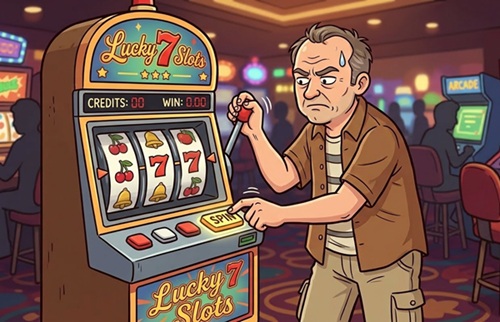
Why some slots feel more “predictable” than others
- High-volatility slots create longer droughts, so any signs of life feel loaded with meaning.
- Bonus teases and near misses create a sense of momentum even when they’re still just losses.
- Cascade games make one spin feel like a sequence, which exaggerates the sense that the slot is building towards something.
- Feature ladders, like Big Bass retriggers or multiplier collection, make players remember the dramatic wins far more vividly than the dead periods around them.
- Popular slots are discussed endlessly online, so folklore hardens into apparent expertise very quickly.
The near-miss effect is especially important here. Slot researchers have been writing about it for years, and the basic idea is simple enough. A loss that looks close to a win can feel psychologically “hotter” than an ordinary blank miss. It can be more frustrating, more arousing and, in several studies, more motivating. This is one reason players come away believing they’ve learned something from a session when, in statistical terms, they may have learned nothing useful at all. The machine has not shown its hand. It’s shown a loss dressed up to feel meaningful.
If I’m being honest, this is where experience can make people more confident and more wrong at the same time. A beginner might simply think slots are random and leave it there. A veteran can start building elaborate private theories. This game tends to bonus after a flat spell. That game often pops when the premiums begin to stack. This one is “cycling”. I’ve heard all of it. I’ve believed versions of it myself at dafter moments than I’d like to admit. The more time you spend with slots, the easier it becomes to mistake familiarity with predictive power.
So is there any science to it at all?
A little, but not in the way hopeful gamblers usually mean. There is science in volatility, hit frequency, RTP, feature structure and compensation models. Those things affect how a slot behaves over time. There is also science in the psychology of near misses and pattern-seeking. What there is usually not, on a standard online slot, is a practical spin-by-spin tell that lets you identify when a payout is “due” in any reliable way.
That means the safest answer is also the least romantic one. You can tell when a slot is volatile. You can tell when it’s stingy in feel. You can tell when its bonus architecture is doing a good job of creating tension. You can tell when a game like Starburst is built to behave very differently from Book of Dead, or when Gates of Olympus is designed to feel more explosive than an old low-drama fixed-line title. What you generally cannot do is read a few spins and conclude that the machine is now primed to cough up because of what it’s just done.
If you want the blunt version, here it is. Most of the time, “it’s due” is not insight. It’s emotion wearing the clothes of insight. That doesn’t make the player foolish. It makes the slot effective. These games are built to create exactly that sensation of almost-there, just-one-more, now-it’s-waking-up. The problem comes when players mistake that sensation for evidence.
My longer answer
In most modern online slot play, no, you really can’t tell when a slot is about to pay out. What you can tell is when a game has been designed to make you feel that way. That’s not the same thing. And once you understand that difference, a lot of slot folklore suddenly starts looking less like hard-won expertise and more like a very expensive story players tell themselves to make randomness feel readable.
I still understand the appeal of believing otherwise. It would be lovely if the patterns meant something. It would be lovely if all those teases, droughts and almost-bonuses were building towards a moment you could sniff out before everyone else. But lovely and true are not the same thing. In slots, they very rarely are.