
UK Gambling
Deposit Limits
Do Deposit Limits Actually Help?

I’ve been around online casinos long enough to remember when deposit limits felt like a box-ticking afterthought, something buried in account settings for the very few people disciplined enough to go looking for it. Now they’re being pushed much harder by the UK regulator, given more visibility, and wrapped in the language of empowerment. Fair enough. The obvious question is whether they actually work.
By Rob Hill
Yes, they can help. But only when they’re simple, honest, and difficult to wriggle around.
The trouble is that UK deposit limits have spent too long being confusing, too easy to bypass, and too dependent on players using them at exactly the moment when players are least likely to be calm and sensible.
Why I think this question matters more than it sounds
This isn’t just a dry settings-menu issue. Deposit limits sit right in the middle of a bigger argument about modern British gambling. Are we actually building tools that help ordinary people stay in control, or are we mostly creating a forest of nudges, prompts and menus that sound responsible but don’t change very much when somebody is truly in trouble?
In principle, I’ve always had some sympathy for deposit limits. They’re one of the few safer gambling tools that try to put a bit of friction between impulse and action before the money is gone. That matters. By the time you’re chasing losses, bargaining with yourself, or trying to turn a nasty session around, the rational part of your brain is often no longer running the show. A limit set in advance can at least force a pause. It can interrupt momentum. And in gambling, momentum is often the villain.
The Gambling Commission clearly agrees with that basic logic. From 31 October 2025, operators have had to prompt customers to set a financial limit before the first deposit, make it easier to review or change those limits later, and keep the tools clearly visible and accessible. Customers also have to be prompted at least every six months to review their account and transaction information, with the option to receive reminders more often. On paper, that’s a sensible shift. It moves deposit limits out of the attic and into the main hallway, where people might actually see them.
The problem is that a tool can be visible and still not be very good. That has been the real weakness of deposit limits for years. Too often, they’ve looked clearer than they were. A customer thought they were setting a hard cap, only to discover later that the operator’s version of a “deposit limit” wasn’t really a simple cap on cash paid in. In some cases, the limit could be affected by withdrawals or other calculations, which made the whole thing far more complicated and less absolute than the average punter would reasonably expect.
What players assumed
“Deposit limit” sounds like a plain-English promise. I put in £100, I’ve hit the limit, and that’s that.
What some operators meant
Something closer to a moving figure, where withdrawals could create extra room to deposit again. That’s exactly the sort of thing that confuses people.
Why that matters
A safer gambling tool stops being much of a safeguard if the player and the operator are using the same words to mean different things.
That is why the newer rules coming into force on 30 June 2026 are more important than they may first appear. From that date, operators must offer a deposit limit based solely on the amount a customer pays into the account over a set period, and only that type of gross limit may be called a “deposit limit”. Other kinds of limits can still exist, but they must be described properly and cannot masquerade under the same name. Frankly, I’m amazed it took this long. If a regulator has to clarify what the word “deposit” means in a deposit limit, that tells you the market has wandered into silliness.
This is where my answer starts to split in two. Do deposit limits help? Yes, in the narrow and sensible sense that a real, properly defined deposit cap can absolutely stop further cash from going in once it has been reached. The Commission’s updated rules are quite clear that the system must prevent further deposits until the period resets or the customer chooses to increase the limit, and increases are subject to a cooling-off delay of at least 24 hours. Reductions, meanwhile, are meant to take effect immediately. That is all good, practical design. It reflects the obvious truth that making a limit looser should be harder than making it tighter.
But here is the other half. Help whom? Help when? Help against what? If we’re talking about an ordinary player trying to keep a lid on monthly spending, then yes, deposit limits can be genuinely useful. I know plenty of gamblers, including experienced ones, who aren’t in crisis but still want a firm line they can’t cross during a bad evening. For them, a deposit limit isn’t an emergency brake. It is more like a guardrail, and there’s real value in that.
Where I think deposit limits really do help
They help people who want structure before the wheels come off.
They help turn good intentions into something firmer.
They help create a cooling-off gap when somebody is tempted to loosen the leash after a bad run.
And they help most when they’re set in a sober moment, not in the middle of a session that’s already gone rotten.
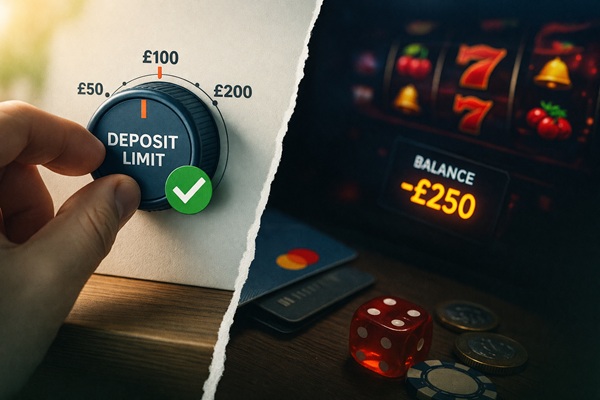
That last point is crucial. Deposit limits are a pre-commitment tool. Their whole value lies in the fact that they’re meant to be set before temptation arrives in full force. In that sense, they’re a bit like keeping your bank card out of reach before a night out. Once you’re already halfway through making stupid decisions, the best tool in the world is less effective than it was half an hour earlier. This is not a flaw unique to gambling. It’s how self-control works in almost every area of life.
Still, I don’t think the industry should flatter itself too much. A lot of the official language around deposit limits sounds cleaner than the reality. The Commission talks about empowering consumers, improving awareness, and making limit-setting more effective. All reasonable. But even its own consultation work pointed to a basic awkwardness. In summer 2024, research commissioned by the regulator found that up to a third of respondents saw financial limits as an inconvenience or thought they would have little impact on what they spent gambling. That doesn’t mean the tool is useless. It does mean many customers either don’t trust it, don’t value it, or don’t believe it changes their behaviour enough to bother.
And I can see why. One operator-level deposit limit is still just one operator-level deposit limit. If a player has five gambling apps on the phone, the “stay in control” story becomes an irrelevance. The Commission did explore the idea of cross-operator deposit limits, but decided not to take immediate action after the call for views failed to produce convincing evidence and raised practical concerns around privacy, fairness and whether it might simply push people toward unlicensed sites. Again, fair enough as far as it goes. But let’s be honest about what that means. The current British model still relies heavily on the customer behaving consistently across a fragmented market.
The biggest weakness
Deposit limits can be strict inside one account and almost meaningless across a wider gambling routine. If somebody is determined, the British market still gives them plenty of places to move next.
The biggest strength
For a large chunk of ordinary players, absolute perfection is not the point. A cleaner, clearer cap inside the account they actually use most may still prevent a lot of stupid extra spending.
That is why I resist both lazy extremes. I don’t buy the cynical line that deposit limits are just pointless PR. That’s too glib. Nor do I buy the fantasy that a better interface and a clearer definition have somehow solved the problem. They haven’t. What they have done is make a flawed tool less muddled and potentially more honest. That’s worthwhile. It just isn’t miraculous.
There’s another irony here as well. The more visible deposit limits become, the more they start to expose a contradiction in the wider market. Gambling businesses want to say, quite rightly, that customers should have tools to manage their spending. At the same time, many of those same businesses are designed to keep customers depositing, returning, and re-engaging. This doesn’t make deposit limits meaningless, but it does mean they sit inside an environment that often pulls in the opposite direction. A tool can help and still be swimming against the tide.
From a player’s perspective, that means the best deposit limit is still the one backed by honesty, not just software. If you know you’re the sort of gambler who treats limits as a challenge, or who simply hops to another site the moment one account closes the hatch, then a deposit limit will not rescue you on its own. If, on the other hand, you’re a normal, fallible human being who mainly needs a hard line to stop a bad evening from becoming a terrible one, then yes, it can absolutely help. Quite a lot, in fact.
My verdict
Deposit limits do actually help, but not because they’re clever or comprehensive. They help because a clear, genuine cap can interrupt the worst habit in gambling, which is the temptation to keep feeding the machine after your better judgement has already left the room. The new UK rules improve the tool by making it more visible and less slippery. They don’t make it foolproof, universal or profound. In gambling terms, it’s not a cure. It’s a brake pedal, and a reasonably useful one.
So if you want the clean answer to the title, here it is. Yes, deposit limits actually help, at least when they’re properly defined, clearly presented, and used by players who genuinely want a boundary. They are better now than they were. They should become better again when the gross-deposit definition takes over in June. But they remain one-account tools in a many-account world, and that means their power has limits of its own.
For me, that’s the sober conclusion. Not cynical, not starry-eyed, just honest. Deposit limits are worth having. They’re worth improving. And they’re a damn sight more useful when they mean what ordinary people think they mean. But if the wider market wants to pretend that better deposit-limit wording alone will solve the deeper mess of digital gambling harm, it’s kidding itself.