
How Do You Know If You’re Playing at a Black Market Casino?
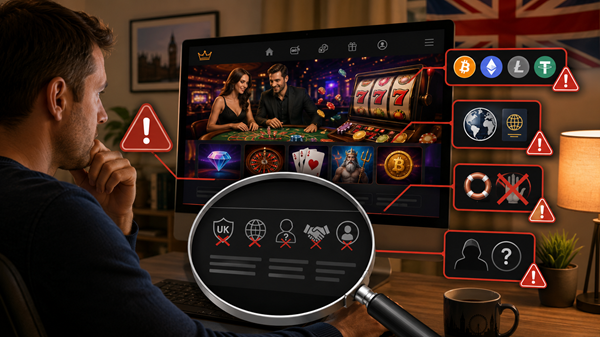
The unfortunate answer is that you may not know straight away. That’s the whole problem. Black market casinos don’t greet British players with a flashing warning that says, “By the way, this site isn’t properly licensed for you.” They do the opposite. They borrow the look, language and style of normal online casinos, then hope you don’t check the small print at the bottom of the page.
By Brian Taylor | 6 May 2026
Black market casinos are constantly in the news because regulators have finally accepted that the illegal market isn’t confined to a tiny corner of the internet full of misspelt banners and cartoon villains. It’s a real consumer problem. The UK Gambling Commission has described illegal gambling as unsafe and unregulated, and it’s warned that many illegal gambling websites can look indistinguishable from legal ones. That last point is the one players should pay most attention to. If every black market casino looked like it had been built in 2009 by a man working alone in a shed, nobody would need to read this article.
The danger isn’t just that a site lacks a British licence. The danger is what that absence means when something goes wrong. If your withdrawal is refused, your balance vanishes, your identity documents are mishandled, your bonus win is voided, or your account is closed without a fair explanation, you’re not standing in the same place you would be with a properly licensed UK operator. The Gambling Commission doesn’t regulate that casino. The British complaints route won’t be available. An approved ADR provider will not be part of the picture. GAMSTOP will not work. The terms may be written to suit the operator rather than the customer.
So the question you have to ask yourself isn’t “Does this site feel like a real casino?” Of course it does. The real question is “Does this site show the signs of being legally allowed to serve players in Britain?” That is a much colder, more practical test, and it starts with the website itself.
The first check: what licence does the footer show?
Scroll to the bottom of the site. That might sound like obvious advice, but it’s often the quickest way to sort a licensed UK casino from one pretending to be safe.
This is where a lot of people get caught. They see the word “licensed” and stop reading. That’s not enough. A casino can be licensed in a jurisdiction that’s perfectly fine for players in most of the world, but still be illegal for British players. The UKGC is very clear that a gambling licence from another country doesn’t permit a company to provide gambling to consumers in Britain. So if a casino is toting an offshore licence while accepting British deposits, that shouldn’t reassure you. It should make you ask why it doesn’t have the licence that actually matters.
A proper UK-facing casino shouldn’t make you play detective for twenty minutes. It should name the licence holder clearly and provide enough information for you to verify the business on the public register. The register isn’t pretty, and it’s not fun to use, but it’s still the cleanest test. Search the brand. Search the company name. Check the domain. If the site you’re on isn’t listed under the licence holder’s authorised domains, don’t go any further with the casino.
Seven on-site warning signs
- No Gambling Commission licence details in the footer.
- A licence issued by another country, but not a British licence.
- “Not on GAMSTOP” used as a selling point.
- Crypto-first deposits, especially where normal UK payment options are limited or missing altogether.
- No approved ADR route for unresolved gambling disputes.
- Bonus terms that look unusually generous, vague or one-sided.
- Terms that ban players from restricted countries while still letting you sign up from Britain.
The GAMSTOP point is the clearest warning sign of all. Licensed online gambling operators in Britain are required to participate in the national online multi-operator self-exclusion scheme. If a site markets itself as “not on GAMSTOP”, it’s not offering you a harmless alternative. It’s openly appealing to people who may be trying to get around one of the main safeguards in the British system. That should be enough to make any UK player walk away.
The wording may be softer than that. You might see “players accepted during self-exclusion”, “no UK restrictions”, “freedom from UK limits”, “no intrusive checks”, or “play without barriers”. The pitch varies, but the meaning is the same. A safe British operator doesn’t sell itself by promising that British protections won’t apply. If the marketing sounds like it was written for someone who has been blocked, excluded or restricted elsewhere, you’re not looking at a healthy player proposition.
The “looks normal” trap
These signs can make an unlicensed site feel safer than it is.
That first point matters more than it used to. Players have often treated familiar games as a safety shortcut. If they can see big-name slots, they assume the casino must be legitimate. I understand the instinct, but it’s not enough. The regulator has warned that licensed software has appeared on unlicensed sites available to British consumers. That doesn’t mean every familiar-looking game is suspect, but the presence of familiar games isn’t a licence check. Only the actual licence is the licence check.
Crypto is another clue, although it needs a little care. Cryptocurrency itself is not the whole issue. The issue is what the payment setup tells you about the casino’s relationship with British regulation. If a casino is pushing crypto deposits heavily, offering barely any normal UK payment options, and wrapping the cashier in language about privacy, anonymity or no bank checks, I would be extremely cautious. The UKGC’s work on the illegal market has noted the role of digital currencies in creating new opportunities for illegal gambling. From a player’s point of view, crypto can also make complaints messier, withdrawals harder to track, and recovery options weaker if the operator decides to play games with your money.
Then there are the terms and conditions. I know nobody wants to read them, but black market sites often reveal themselves in the small print. Look for country restrictions. Look for governing law. Look for dispute language. Look for impossible bonus powers. Look for clauses that say the operator can confiscate funds at its sole discretion, close accounts without explanation, delay withdrawals indefinitely, or require verification only after you win. A British licence doesn’t always guarantee perfect conditions for players, but a UK-facing licensed operator is at least expected to use fair and transparent terms.
The test I’d use before depositing
Before I put a penny into a casino I don’t already know, I’d ask these five questions.
- Can I find the exact domain on the Gambling Commission’s public register?
- Does the footer name a real UK licence holder and licence account number?
- Does the site participate in GAMSTOP rather than promoting that it avoids it?
- Can I see a proper complaints route and an approved ADR provider?
- Do the terms feel like rules for both sides, or weapons for the operator?
The ADR question is another important one. UK-licensed operators must offer dispute resolution through an approved independent body when a gambling dispute can’t be resolved internally. If a casino doesn’t show a credible complaints and ADR route, that tells you something. It may still have a support email and live chat. It may even have a complaints page. But if the final answer is basically “our decision is final”, you shouldn’t treat that as normal British consumer protection.
The same applies to safer gambling tools. A legal UK operator should give you meaningful account controls, self-exclusion information, safer gambling links and practical limit tools. An unlicensed site may mimic some of that because it knows the page needs to look respectable, but there is a difference between a real safety system and a decorative safer-gambling footer. If deposit limits are hard to find, self-exclusion doesn’t apply, GAMSTOP isn’t named at all, and responsible gambling language reads like an afterthought, don’t ignore it.
Another clue is how the site talks about verification. Black market casinos often market themselves on low friction: no hassle, no intrusive checks, fast sign-up, instant play. That can sound attractive, especially to players who are sick of document requests at licensed casinos, but the relaxed sign-up is often the bait. The real test comes when you try to withdraw. A bad offshore operator may let you deposit easily, then suddenly become fascinated by your identity, your payment route, your betting pattern and a term you supposedly breached. The safe question isn’t “will they let me join?” It’s “what happens when I win?”
What not to rely on
There’s also the mirror-domain problem. Some black market brands use multiple domains, redirects, clones and slightly altered addresses. They may look connected to a known brand, or they may use a name close enough to make the careless player relax. That is why the exact domain matters. Not the brand name in your head. Not the logo. Not the colour scheme. The exact domain you’re using. If the UKGC register doesn’t list that domain under a licensed operator, assume the risk is yours until proven otherwise.
I also dislike sites that are coy about ownership. A legitimate UK-facing casino shouldn’t make it difficult to work out who operates it. You should be able to identify the company, the licence holder, the complaints route and the regulatory position without needing to interrogate the footer like a murder suspect. If the site gives you only a brand name, a contact form and a promise that it’s “fully regulated”, that’s not enough.
My own rule is simple: the safer a casino is, the easier it is to verify. It may still have flaws. It may still have slow withdrawals, annoying checks or clumsy support. But its legal status shouldn’t be a mystery. If you are thirty tabs deep, trying to work out whether a licence from another country somehow covers you as a British player, you already have your answer. Walk away.
That may sound harsh, but the alternative is worse. Black market casinos rely on uncertainty. They rely on players seeing one reassuring sign and ignoring the missing ones. A licence logo here. A famous slot there. A chat agent saying “we accept UK players”. None of that is the same as being licensed in Britain. If the operator is outside the British system, you’re choosing to play without the protections that system provides.
So, in a nutshell, how do you know if you’re playing at a black market casino? You look for what’s missing as much as what’s present. No UKGC licence record. No exact domain match. No GAMSTOP participation. No approved ADR route. Offshore licence language. Crypto-first payment pressure. Too-good-to-be-true bonuses. Vague ownership. Terms written like a trapdoor. Any one of those is a warning. Several together should be enough. A safe casino doesn’t just look like a casino. It proves, in boringly verifiable detail, that it’s allowed to serve you.