
UK Gambling
Non-GamStop
Is It Ever Safe to Play at Non-GamStop Casinos?
I understand why people ask this. When they ask it, they’re not really saying, “Please give me a lawyer’s take on it” They mean something more practical. If a site looks polished, holds some kind of overseas licence, offers fast crypto withdrawals and thousands of slots, can it ever be called safe even if it sits outside GAMSTOP?
By Brian Taylor
My short answer
If a casino is “non-GamStop”, then for a UK player, it sits outside the British licensed system by definition. That means it also sits outside the bundle of protections that make UK gambling, for all its frustrations, more accountable than the offshore alternative. You can still find glossy websites and smooth sign-up systems out there. What you cannot honestly find, from a UK-facing point of view, is safe casinos.
The first thing worth clearing up is the basic definition. In Great Britain, all online gambling operators licensed by the Gambling Commission must participate in GAMSTOP. That’s been the rule since 2020. So when somebody says “non-GamStop casino”, what they’re really describing is an operator outside the British licensing framework. It may hold a licence somewhere else. It may be perfectly happy to plaster that licence across the footer. It may even look cleaner and more modern than some UK-licensed sites. None of that changes the core fact. For UK-facing play, it is outside the regulated British system and off-limits to British players.
That point can sound stuffy, but it’s actually the whole argument in a single sentence. People often talk about safety as though it were just one quality among many, like game variety or mobile design. It’s not. Safety in online gambling is a structure. It’s the combination of licensing, self-exclusion, complaint handling, fund disclosures, safer gambling duties, bonus restrictions, identity checks and enforcement. Once you step outside that structure, you’re no longer asking whether a site feels decent. You are asking whether appearances can substitute for safeguards.
This is where the “yes, but…” argument starts
People will say some offshore casinos hold legitimate licences in other jurisdictions. They will say some process withdrawals promptly, offer real games from known providers, and answer support emails. All true, some of the time. The problem is that this is not a serious enough definition of safety for a UK player. “It paid me once” is not the same thing as “this is a site I can trust when something goes wrong”.
That distinction matters because safe gambling isn’t tested on a simple deposit. It’s tested at the point of friction. When the withdrawal stalls. When the source-of-funds request arrives. When the account is limited. When a bonus dispute appears. When you need to self-exclude. When you realise the site’s idea of responsible gambling is a tiny link in the footer that doesn’t go anywhere. That’s when the British regulatory framework, tedious as it can sometimes feel, begins to show its value.
What UK-licensed casinos have that non-GamStop sites do not
GAMSTOP integration
Every online operator licensed in Great Britain must be part of the national multi-operator self-exclusion system. Non-GamStop sites are outside it by design.
Complaint routes and ADR
Licensed operators in Great Britain must meet complaint-handling standards and offer access to independent ADR. Offshore sites do not owe UK players that route.
Fund-protection disclosure
UK-licensed businesses must tell you what level of customer-fund protection applies if they go bust. Offshore sites aren’t operating under that British disclosure regime.
This is also why I find the “it’s safe if you’re disciplined” defence so flimsy. It shifts all the burden onto the player and pretends the operator’s environment barely matters. That’s nonsense. Of course self-control matters. Of course adults make their own choices. But the whole point of the British system is that gambling safety is not left entirely to private willpower. It’s supported, imperfectly but meaningfully, by rules that apply whether you’re feeling strong, weak, reckless or desperate.
And desperation is not some abstract concern here. A huge part of the non-GamStop market’s appeal is precisely that it offers routes around restrictions. Around GAMSTOP. Around affordability friction. Around the checks and barriers that make people grumble when they’re using legal UK sites. That’s not a side issue. It’s the business model’s emotional engine. The sites are attractive to many people for exactly the reason they’re unsafe.
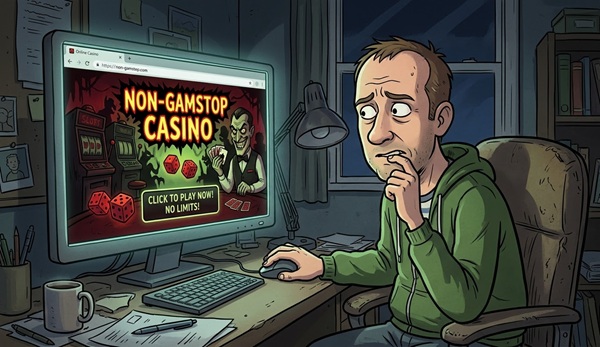
The real question is not “Can it work?”
Plenty of dangerous things work right up until they don’t. The real question is whether a UK player is protected when the easy bits stop being easy. In that test, non-GamStop casinos fail before you’ve even loaded the lobby.
Over the last year, the wider context has actually made me less sympathetic to the “maybe some of them are fine” line, not more. The Gambling Commission has started talking much more aggressively about the illegal online market, illegal ads and the way offshore operators market themselves to British consumers through phrases like “not on GamStop”. Tim Miller accused Meta in January of turning a blind eye to illegal gambling advertising that effectively acts as a gateway around British protections. More recently, The Guardian reported that major AI chatbots were pointing vulnerable users towards offshore casinos not on the self-exclusion scheme. That’s not a healthy ecosystem with a few misunderstood alternatives in it. It’s a predatory grey zone feeding off the gaps in the regulated one.
Then there’s the issue of trust itself. British players often underestimate how much value there is in boring regulation. UK-licensed sites must make clear how customer funds are protected if the business becomes insolvent. They must follow complaint standards. They must allow ADR after the internal process. They must integrate with self-exclusion. They sit within a public register system where you can at least verify who they belong to. That still doesn’t make every UK casino enjoyable, but it does mean there’s an accountable framework around the misery if things turn sour.
On an offshore non-GamStop site, what do you have instead? Usually a patchwork. Maybe a foreign licence with different standards. Maybe a customer support team that sounds helpful until you ask the wrong question. Maybe a promise of “responsible gambling tools” that can be bypassed, ignored or quietly rendered meaningless. Maybe crypto, which many players treat as a sign of sophistication when it often just means you’re carrying more risk yourself. That’s not the same thing as safety. It’s a different bargain altogether, and for UK players it’s the wrong one.
Why the answer has to be “no” for UK players
- If it’s non-GamStop, it’s outside the British licensed framework.
- If it’s outside that framework, it’s outside the full package of British consumer protections.
- If a site’s attraction is that it helps people dodge British safety barriers, that’s a warning sign, not a selling point.
- If something goes wrong, your routes to redress are weaker, murkier or simply not built for you as a UK consumer.
- And if you’re self-excluded, the whole premise of using such a site is already evidence that it’s unsafe for you.
I know what some readers will still be thinking. They will say the UK system can feel restrictive, overbearing, nosy and occasionally infuriating. Fair enough. They’re not wrong. I have plenty of criticisms of the British market myself. Verification can be clumsy. Affordability friction can be blunt. Bonuses are less exciting than they used to be. Some operators are still miserable at communication. All true. But none of those irritations add up to a compelling case for walking off the map entirely.
That is where I think the non-GamStop debate often goes astray. It treats frustration with the UK system as if it were a positive argument for offshore play. It isn’t. At best, it’s an explanation for why people are tempted. The truth is uglier and simpler. Non-GamStop casinos attract attention because they promise freedom from the very controls that exist to stop gambling becoming more destructive. For a UK-facing audience, that’s not a feature we should flatter with euphemisms.
So, is it ever safe?
For UK players, no. Not in the serious sense of the word “safe.” You may find offshore sites that look slick, pay quickly on a good day, and seem perfectly civil while nothing is going wrong. That’s not enough. Safety is not “it seemed fine when I tried it”. Safety is regulation, accountability, redress, self-exclusion, disclosure and enforceable standards. Non-GamStop casinos sit outside that British safety net by definition, which is exactly why the honest answer has to stay no.
And that, in the end, is the entertainingly unexciting truth. If you’re a UK gambler looking for a loophole with a happy ending, this is not one. A non-GamStop casino may look like an escape hatch. In practice, it’s much closer to a side door marked “Here Be Consequences”. Rarely has “enter at your own risk” been more apt a warning, but my advice is never to enter at all.