
Self-Exclusion
What Really Happens After You Self-Exclude?
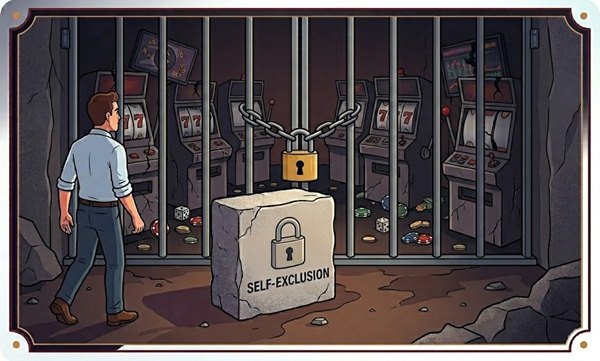
A lot of people talk about self-exclusion as though it’s a big red button. Press it, the gambling stops, and that’s the end of the story. I understand why people want to believe that. In reality, there’s quite a lot more to it. Self-exclusion can be one of the most effective tools a struggling gambler has. It just isn’t a magic bullet, and the difficult bit often starts after you’ve signed up, not before.
By Brian Taylor
What happens in short
If you self-exclude properly, your accounts should be closed, your remaining funds should be returned, and gambling marketing should stop. That’s the theory. In real life, the block can take time to bite, some people still leak into gambling through other routes, and the emotional urge to gamble doesn’t disappear because a database says it should.
The reality
Self-exclusion is strongest when it’s treated as the start of a wider recovery plan, not the whole plan by itself.
The catch
GAMSTOP covers online gambling companies licensed in the United Kingdom. It doesn’t reach everything else that a determined or distressed person might use next.
The first thing to say is that self-exclusion in the UK iGaming market isn’t a shameful niche option. Every online gambling company licensed in Great Britain has had to be part of GAMSTOP since March 2020, which means there is now one central online self-exclusion route for licensed remote gambling. That’s a huge improvement on the old patchwork method, where people had to block themselves site by site and hope they hadn’t forgotten half the places they used. It’s one of the better reforms the industry has been forced to accept.
If you use GAMSTOP, you can currently choose a minimum block of six months, one year, five years, or five years with auto-renewal. Once you’ve registered, you can’t cancel the exclusion during that minimum period. That last part matters because people in distress are often horribly persuasive with themselves. A system that lets you reverse the decision in a weak moment would be close to pointless.
What should happen straight away?
Accounts close
Operators are obliged to close your customer accounts, not suspend or pause them.
Funds come back
Any money sitting in the account should be returned, though in practice, you may still need to chase the operator directly to arrange it.
Marketing stops
Your details should be removed or flagged in company and group marketing databases, and this should happen quickly.
That isn’t just good practice; it’s built into the rules. The Gambling Commission’s remote self-exclusion code says operators must close the accounts of self-excluded customers and return the funds held there. It also says they must take all reasonable steps to prevent any marketing material from being sent to self-excluded customers, and they must remove or flag the person’s details in company or group marketing databases within two days of receiving the completed self-exclusion notice. In other words, if you self-exclude and then the same operator, or a sister site in the same group, keeps nudging you with offers, that can’t be written off as an admin mistake. It’s exactly the sort of failure the rules are meant to prevent.
But this is where reality starts to matter more than theory. If you register with GAMSTOP, the block isn’t necessarily instantaneous to the second. The service says it can take up to 24 hours to become effective. That may not sound like much, but if somebody has hit a crisis point and signs up in the middle of a spiral, 24 hours can be a very long time. This is one of the reasons I think self-exclusion is most powerful when it’s done alongside other barriers, not instead of them.
GAMSTOP itself now pushes that wider message more openly than it once did. The site points people towards bank gambling blocks, device-level blocking software, and separate self-exclusion tools for betting shops, land-based casinos, arcades and bingo premises. That’s sensible. Online self-exclusion is a strong wall in one part of the maze. It’s not the whole maze.
What it does cover
Online gambling companies licensed in the United Kingdom, including new licensed operators that join the market later.
What it doesn’t cover by itself
Offshore sites outside the UK system, physical venues, payment routes, device access, or the raw human urge to gamble when you’re already in a bad state.
That last point is the hard one, because it’s where some of the public conversation becomes dangerously sentimental. Self-exclusion is not a cure. It’s a barrier. A very useful barrier, yes, but still a barrier. If somebody is deeply determined, panicked, or already looking for loopholes, they may start searching for the gaps. The Gambling Commission’s own 2025 illegal-market research makes grim reading on this front. It found that self-excluders often continued to gamble, with the ability to access any site at all being the main attraction of illegal operators. The same research said the main pathway into those sites was through search engines, with people actively looking for websites “not on GAMSTOP”, and that self-excluders reported heavy direct marketing and targeted advertising on social media. That isn’t a failure of the idea of self-exclusion. It’s a reminder that a good tool can still be undermined by a bad ecosystem.
So what really happens after you self-exclude? On paper, a few immediate things happen. Your licensed online accounts should be shut. Your funds should come back. Your name should stop circulating around marketing lists. Your ability to sign up again or log in should be blocked when operators check your details against the GAMSTOP system. If that all works as intended, the legal online market gets much harder to access very quickly.
What happens emotionally is more complicated. Some people feel relief almost at once. Others feel panic, boredom, grief, or a sudden regret – the sense that perhaps they overreacted and can manage just fine. That’s why I always find it a bit irritating when commentators talk about self-exclusion as though it were simply a technical switch. It is a technical switch, yes, but it’s also a psychological event. You’re closing one route to a behaviour that, for many people, had become part of their daily rhythm, their fantasy life, or their crisis response. Of course that leaves a void.
The part that many people don’t realise
Your self-exclusion doesn’t simply vanish from the records when the minimum period ends.
GAMSTOP says if you do nothing, the exclusion stays in place for a further seven years after the minimum period expires.
If you want it removed after the minimum period, you have to contact GAMSTOP and go through a cooling-off process.
That is one of the most important details in the whole system, and I suspect plenty of players still don’t know it. GAMSTOP says it will not contact you when your minimum period expires. If you do nothing, the block remains in place for up to a further seven years. If you want it removed, you have to contact the service by phone, and there’s then a cooling-off period of at least 24 hours before the exclusion is lifted. Even after removal, GAMSTOP says it will inform operators for a seven-year period that you were previously self-excluded. The system is clearly designed to make re-entry into gambling a conscious, friction-filled decision rather than a casual relapse.
And even then, there are further bumps in the road. GAMSTOP’s own help material says that after your cooling-off period, you may still have to wait a little while for operators to update their records, and it explicitly says it cannot guarantee that all gambling companies will remove the block from their sites. In other words, even after the formal exclusion is lifted, some operators may still say no, or at least not yes straight away. To some players that will sound unfair. To me, in a safer-gambling context, it sounds defensible.
The other thing players should know is that if you do manage to gamble while self-excluded, that doesn’t mean the self-exclusion was worthless. It means something has gone wrong in the operator’s procedures. The Commission says operators should take reasonable steps to stop self-excluded customers from gambling, and if it happens anyway, you should tell the operator, and you may also want to tell the regulator. The catch, and it is an important one, is that the Commission also says it cannot provide refunds for money lost in those situations. That’s another of those awkward truths players need to know upfront. Regulatory interest and personal compensation are not the same thing.
What I’d tell anyone self-excluding
Don’t treat GAMSTOP as the only tool you need.
Add bank blocks, blocking software, and venue-level exclusions where relevant.
Chase the return of your balances directly rather than assuming the money will glide back to you on its own.
And be ready for the mental aftershock, because that is often where the real work begins.
What I think the industry still gets wrong
Marketing failures remain unforgivable because the rules on them are so clear.
Too many people still discover the limits of self-exclusion only after a crisis moment.
And the legal market still coexists with a wider offshore casino scene that actively targets people trying to quit.
The scale of the system tells its own story. Official GAMSTOP data says that by the end of 2025, more than 562,000 people were actively excluded, with 58,675 registrations recorded in the second half of the year alone. The same update said registrations among 16- to 24-year-olds rose 40% year-on-year in the second half of 2025, and that age group accounted for 29% of new registrations. Five-year exclusions remained the most popular choice, selected by 47% of registrants. You don’t get numbers like that if self-exclusion is some marginal backwater of the system. It has become a major part of how Britain now manages gambling harm.
Which brings me to the honest conclusion. Self-exclusion works, but not in the childish sense of “problem solved”. It works by making the regulated online market harder to access, by forcing distance between the gambler and the habit, and by reducing the number of easy moments of relapse. That is valuable. Sometimes enormously valuable. But if the wider environment still points distressed people towards illegal operators, if marketing still slips through, or if the person self-excluding thinks this one act has somehow fixed everything else in their life, then the limits of the process quickly become apparent.
So what really happens after you self-exclude? The official answer is that the accounts close, the funds come back, the marketing should stop, and the block goes into place. The real answer is that you have just taken one of the most useful steps available to someone with a gambling problem, but it’s still only a step. A very strong barrier goes up. What you do next is what decides whether it becomes a turning point or just a timeout.