
UK Sports Betting
Market Share
Why Is It So Hard to Break Into the UK Sports Betting Market?
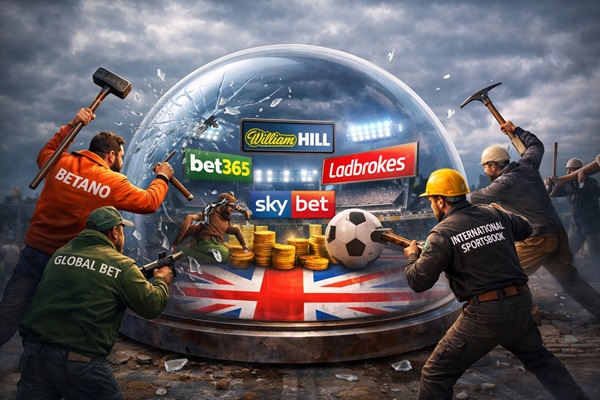
New sportsbook brands keep arriving with big international reputations, launch offers and declarations of intent. In response, the market barely even blinks. A couple of years later, some of them are still fighting to be noticed, and some of them are gone altogether. After watching this cycle repeat itself, I think the answer is fairly simple. Britain’s betting market looks open from the outside, but in practice, it behaves like a fortress.
By Rob Hill
The short answer
It’s hard because the biggest brands already own the shop. They own the football weekends, the racing rituals, the apps people have had on their phones for years, the trust built around payouts and account handling, and a huge share of the paid search visibility. A new entrant isn’t just trying to launch a decent sportsbook. It’s trying to persuade British punters to abandon their muscle memory.
I’ve said before that the UK online casino market is crowded. Sports betting is worse. It’s not just crowded, it’s culturally occupied. The biggest names aren’t merely operators with strong products. They’re habits, references and default settings. When people think of a football acca, an in-play bet, a Cheltenham offer, a bet builder or a quick racing price check, the same handful of brands come to mind again and again. That makes breaking in brutally difficult, even for companies with money, technology and serious international pedigree.
Betano is the obvious case study because it arrived in Britain in a way that should, on paper, have made a dent. It launched through BVGroup in April 2024, just before Euro 2024, carrying the advantage of major tournament sponsorship, a growing international reputation and plenty of confidence about making a mark in one of the world’s biggest regulated betting markets. If you were drawing up a checklist for a credible challenger launch, it had most of the boxes ticked.
By March 2026, Betano still doesn’t look like a genuine market-breaker in the UK. It exists, it’s licensed, it’s active, and it’s clearly not a failed experiment. But neither has it forced its way into the domestic front line. That tells us something important. In Britain, even a brand with global reach and serious sponsorship muscle can struggle to shift the hierarchy.
The market is already heavily occupied by a few giants
This is the first and biggest problem. New entrants aren’t walking into an empty field. They’re walking into a room where the best seats have been taken for years, and the people in them have no intention of leaving.
One of the clearest snapshots of that comes from Adthena’s UK sports betting paid-search click-share data for February 2026. William Hill was on 37.83%, bet365 on 16.2%, Ladbrokes on 14.42% and Sky Bet on 10.44%. Put those four together and you’re already looking at 78.89% of tracked click share. Add Coral, Paddy Power, Betfred, BoyleSports, Betfair and Betway, and the “others” bucket is down to 7.61%. That isn’t a perfectly direct revenue measure, and I wouldn’t pretend it is, but as a proxy for attention and discoverability, it makes the point very clearly.
Chart: where the visibility sits in UK sports betting
This uses Adthena’s February 2026 paid-search click-share data. It isn’t the same thing as full market revenue share, but it is a very useful illustration of how concentrated the field looks to anyone trying to get noticed.
That’s a vicious starting point for any newcomer. If you’re outside the established elite, you’re not fighting for a neatly defined slice of open ground. You’re scrapping for attention in the shadow of brands that already dominate search, sponsorship, retention and routine. In practical terms, that means you can be good and still remain peripheral. Quite a few challengers have learned that the hard way.
Habit is a much stronger force in betting than many executives seem to think
A punter who’s had the same bookmaker app for years isn’t making a new choice every Saturday. They’re going back to their preferred one. That matters enormously.
Sports betting is ritualistic. Football fans build accumulators the same way other people make tea. Racing punters have their preferred app open before the declarations are even fully digested. Once a player has gone through verification, set their limits, learned the interface and decided the withdrawals are acceptable, the reason to move becomes weaker than outsiders often assume. A newcomer isn’t just selling odds or boosts. It’s asking people to tolerate friction for the possibility of something marginally better.
That’s why “better product” on its own so often isn’t enough. You can launch with a cleaner design, sharper bet builders, smarter same-game markets and a more modern app, and still fail to pull a punter whose entire betting life already lives inside Sky Bet or bet365. Britain’s market isn’t only about who has the best toolset. It’s about who has become part of people’s weekly rhythm.
Visibility is ruinously expensive
Launching a sportsbook in Britain means signing up for a long, expensive argument with brands that already know exactly how to buy attention.
This is where people often underestimate the incumbents. The big names don’t just have market share. They have distribution advantages, existing media relationships, relentless search spend, deep affiliate coverage and years of brand memory. A new operator can buy a burst of excitement around a major tournament, but sustaining that is another matter altogether. Euro 2024 helped Betano look visible during launch season. It didn’t magically rewrite the UK pecking order.
Rhino Bet is a good example of how brutal that dynamic can be. It wasn’t a ghost brand. It had profile, racing emphasis and what I, at the time, described as a significant marketing push. Yet it still confirmed in March 2025 that it would cease UK operations by the end of that month. That’s telling. If a brand can spend, sponsor and still fail to build enough durable share, it suggests the threshold for survival is much higher than a lot of launch rhetoric admits.
BetZone tells a similar story in a slightly different way. It wasn’t a total non-event either. It had made enough noise to be noticed, changed ownership and licensing in early 2025, and later attracted new platform investment. Even so, Richmond Atlantic’s flagship sportsbook brand ceased trading in the UK in December 2025 after four years, with the business moving in a new strategic direction. That phrase is corporate deodorant, obviously, but the meaning is plain enough. The operation did not justify its ongoing costs.
The two closures that should make challengers nervous
Rhino Bet
Closed UK operations in March 2025.
Had a solid brand identity and a significant marketing push.
Still didn’t build enough sustainable momentum to stay open.
BetZone
Ceased trading in late 2025 after four years.
Was active enough to attract ownership changes and platform relaunch attention.
Even a reasonably visible mid-tier run still wasn’t enough to secure long-term survival.
That’s one of the grimmer truths about the UK betting market. You can perform relatively well in the abstract and still not perform well enough. It isn’t a participation trophy environment. It’s a scale environment. If you can’t get to a level where acquisition, retention and operating costs start making long-term sense, respectable visibility may simply mean you lose money more publicly.
Regulation and compliance now hit smaller brands harder
Bigger operators complain about regulation as much as anyone else, but scale lets them absorb pain in ways smaller brands can’t.
This is one of the least glamorous explanations, which usually means it’s one of the most important. The UK market is expensive to operate in properly. Licensing, compliance, safer gambling systems, verification, payments, marketing controls, data handling and ongoing regulatory obligations all cost money. The Gambling Commission’s own annual figures showed total operator numbers in the market falling 3.7% year on year to 2,179 as of 31 March 2025. That doesn’t prove every disappearing operator died because of sportsbook competition, but it does underline that the market is not expanding into infinite space.
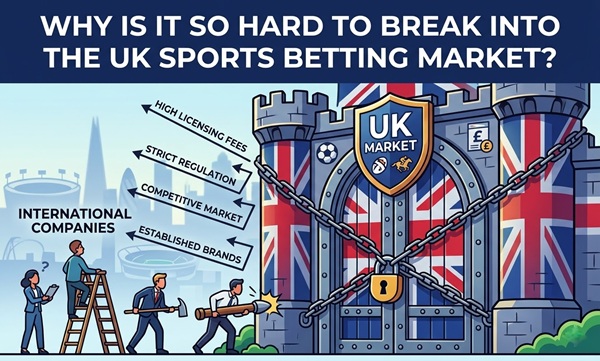
Then there’s the forward pressure. Entain’s leadership said in March 2026 that many smaller operators may struggle under the coming fiscal environment, with Stella David remarking that the bottom quarter of operators have around 1% share each and are “simply not equipped” to ride the tax increases ahead. You don’t have to take that as a noble prophecy from a giant incumbent. It is also, inconveniently, a plausible reading of how this market works. The big groups can weather margin pressure better. The minnows often can’t.
Even when you do everything well, gamblers may just not care
This is the part I think overseas executives sometimes find hardest to accept. The UK customer is not waiting eagerly for their next sportsbook saviour. Quite often, they’re perfectly content with what they already use.
Betano’s UK story captures that perfectly. It didn’t enter like an amateur. It partnered with BVGroup, launched in time for Euro 2024, and had a recognisable international brand behind it. BVGroup itself said Betano was eager to make a substantial impression in the UK, and Kaizen’s own executives openly described Britain as one of the largest regulated online gaming markets in the world. They weren’t wrong. What they perhaps underestimated was how difficult it is to turn global prestige into local habit.
That doesn’t mean Betano has failed. I wouldn’t say that. It means that in Britain, simply being good and serious doesn’t guarantee rapid success. A sportsbook can have decent tech, slick branding, football sponsorships and clear ambition, and still find itself orbiting outside the inner circle. That’s because the UK market doesn’t merely test whether you can launch. It tests whether you can stay relevant long enough to become normal.
So why is it so hard to break into the UK sports betting market?
Because “breaking in” requires far more than launching a decent product. It means cracking habit, surviving against enormous customer-acquisition costs, building trust around payments and account handling, navigating one of the most demanding regulated markets in the world, and doing all of it while the biggest incumbents keep tightening their grip. That is a very long list of things to get right at once.
If I had to boil it down to one sentence, it would be this. The UK sports betting market is hard to crack because the leaders already own the routines, and routines are much harder to buy than awareness. That’s why newer brands can look lively without becoming lasting, and why closures like Rhino Bet and BetZone matter. They’re reminders that visibility is not victory.
My own view is that Britain will still produce successful challengers, but they’ll need patience, deep pockets, product sharpness and a willingness to keep going long after the launch buzz fades. In other words, they won’t really be “breaking in” at all. They’ll be enduring a siege until the market finally accepts they’re staying.