
My Bank Has Blocked My Gambling Payments. How Does That Work, and Can I Undo It?
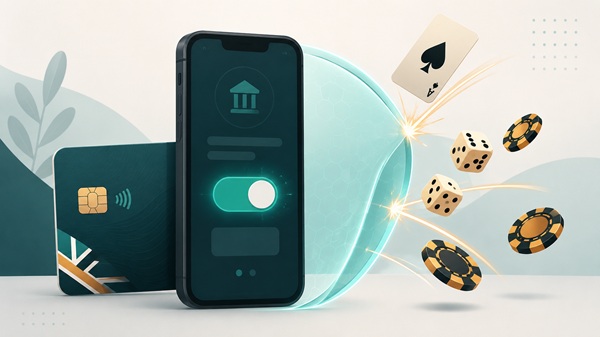
Nearly every major UK bank now lets you block gambling payments with a single toggle in the app. It takes two seconds to switch on and, very deliberately, a lot longer to switch off. Here’s what that toggle actually does, what it quietly misses, and why the waiting period on the way out isn’t a bug.
By Brian Taylor | 10 June 2026
I’ve watched bank gambling blocks go from a novelty that one or two app-based banks offered to something close to standard kit. These days you’ll find one buried in the card settings of most current accounts, sometimes called a gambling block, sometimes a gambling restriction, sometimes hiding under “merchant controls”. Wherever it lives, the promise is the same: flip the switch and your card stops working at gambling merchants.
It’s a useful tool, and I’ll happily say so. But it’s also one of the most misunderstood tools in the safer gambling toolbox. Players switch it on believing they’ve built a wall, when what they’ve really built is a decent fence with a couple of known gaps. Others switch it on in a low moment, feel differently a week later, and are very frustrated to discover they can’t simply switch it back off. Both groups deserve a straight explanation, so here it is.
How the block actually works
When you pay for anything on your card, the transaction carries a merchant category code, a four-digit tag that tells your bank what kind of business is taking the payment. Gambling has its own codes, with 7995 being the big one covering betting and casino transactions. When your gambling block is on, the bank’s systems check that code in real time and decline anything tagged as gambling before the money moves. The decline happens in seconds, at the authorisation stage, which is why a blocked deposit usually fails instantly at the casino cashier rather than vanishing into limbo.
That’s the whole mechanism. It’s not intelligent, it’s not reading the merchant’s name, and it’s not making a judgement about you. It’s matching a code. Which is precisely why it works brilliantly in some situations and not at all in others.
That second factor matters more than banks tend to advertise. The block is built around the assumption that gambling companies identify themselves honestly in the payment system. UK-licensed operators do, because they have to. The murkier end of the offshore market often doesn’t, with payments dressed up as digital services, entertainment or something equally vague. So the block is at its weakest exactly where the gambling is at its most dangerous. If a payment to a gambling site sneaks through your block, report it to your bank. Some banks will investigate the merchant and add it to their block list, and the miscoding itself tells you a lot about who you’re dealing with.
There’s a strange comfort in that for anyone who plays only with UK-licensed sites, mind. Within the licensed system, the block is close to watertight on card payments. It’s the moment you wander outside the licensed market that the fence develops holes, and that’s one more reason, on top of the many I’ve written about before, that offshore sites are off limits for UK players.
The cooling-off period: the bit everyone Googles
Here’s where most of the search traffic on this subject comes from. Turning the block on is instant. Turning it off is not. When you flip the toggle back, the bank doesn’t lift the block straight away. Instead, a cooling-off period starts, and gambling payments stay blocked until it ends. The length varies by bank, but the typical range across the UK market is 48 to 72 hours.
How long you’ll typically wait
Shorter end (several app-based banks): 48 hours
████████████████
Longer end (several high street banks): 72 hours
████████████████████████
Exact periods vary by bank and can change. Check your own bank’s current terms in the app before relying on a number.
Players sometimes treat the cooling-off period as an annoyance, or even a fault. It isn’t. It’s the entire design. Research into these tools found that what makes a block effective is precisely this kind of positive friction. The urge to gamble is often impulsive and often passes. A block you can disable in the same thirty seconds it took to feel the urge protects nobody. A block that makes you wait two or three days means the decision to gamble again has to survive contact with a calmer version of you.
So if you’ve turned your block off and you’re irritated that the casino still won’t take your card, my advice is to sit with that irritation rather than fight it. The delay is doing its job. If the urge is still there in three days, the option will be too. And if part of you is relieved the payment bounced, that feeling is worth paying attention to. It might be telling you the block should stay on, and that it’s worth a conversation with someone, whether that’s GamCare’s helpline, your GP, or somebody you trust.
When the bank blocks you without being asked
There’s a second version of this problem that confuses people: gambling payments declining when you never set up any block at all. A few different things can be going on. Credit cards are the simple one, because using a credit card for gambling with UK-licensed operators has been banned since 2020, so those declines aren’t your bank being difficult; they’re the law. Beyond that, some declines are fraud controls reacting to an unusual payment pattern; some are the bank applying its own risk rules to certain merchants; and some are the gambling company’s payment provider rejecting the transaction on its end, with the casino’s error message unhelpfully pointing the finger at your bank.
If it happens to you, ring the bank and ask the specific question: was this transaction declined by you, and if so, under what control? Don’t accept “it was blocked” as a final answer. You’re entitled to know whether it’s a gambling restriction on your account, a fraud flag, or something else entirely, because the fix is different in each case. And if the bank says the decline came from the merchant’s side, your next conversation is with the casino, not the bank.
A fence, not a fortress
The most important thing I can tell you about a bank gambling block is what it isn’t. It isn’t self-exclusion. GAMSTOP stops UK-licensed sites from letting you in. A bank block stops one set of payment routes from one account. They do different jobs, and the people who get the most out of these tools are the ones who layer them rather than picking a favourite. That’s the thinking behind the TalkBanStop approach promoted by GamCare: talk to someone, block the payments, and self-exclude through GAMSTOP, with blocking software such as Gamban covering the device itself. Each layer has gaps. Stacked together, the gaps stop lining up.
A block on one account also does nothing about money you move elsewhere first, and it travels badly. Switch banks or open a new account and there’s no block waiting for you on the other side unless you set it up again. None of this makes the tool pointless. It makes it one tool, and anyone leaning on it as their only protection deserves to know that before the gap finds them. I’d also say, gently, that if you find yourself mapping out the ways around your own block, that instinct is the clearest sign yet that the block alone isn’t enough, and that the “talk” part of the toolkit is the one to reach for.
Questions worth asking your own bank
Five minutes in the app or on the phone will tell you exactly what you’re working with.
- Do you offer a gambling block, and where does it live in the app?
- How long is the cooling-off period when I turn it off?
- Does it cover every card and account I hold with you, or just this one?
- What happens if a gambling payment gets through while the block is active?
- What extra support can you offer if gambling is affecting my finances?
One practical reassurance before I wrap up, because I know it stops some people from using the tool at all: switching on a gambling block isn’t reported to credit reference agencies and won’t dent your credit score. The thing lenders can see is the thing the block helps with, which is a statement full of gambling transactions. If anything, the block is the credit-friendly option.
So, how does a bank gambling block work, and can you undo it? It works by declining card payments tagged with gambling merchant codes the instant they’re attempted, which makes it near-bulletproof against UK-licensed sites and patchy against the offshore operators who lie about what they are. And yes, you can undo it, but only after a cooling-off period of around two to three days, which exists so that the decision gets made by you on a Tuesday afternoon rather than you at midnight. Use it, layer it with GAMSTOP and blocking software if gambling has stopped feeling like fun, and treat the waiting period with some respect. It’s one of the few mechanisms in this industry built entirely for the player’s benefit. There aren’t many of those, and this one’s free.