
What Is The House Edge? How Casinos Make Money
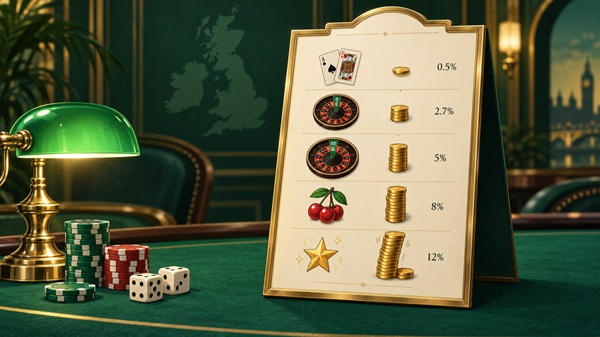
Casinos don’t cheat, don’t need luck, and don’t particularly care whether or not you win tonight. They charge a price, woven into the odds of every game, and most players have never once looked at the tag. I have.
By Brian Taylor | 16 September 2026
Over the past few weeks I’ve written about betting systems that can’t beat the maths and slot machines that don’t need to cheat, and on both topics I kept coming back to the same thing: the house edge. It’s the answer to half the questions players ask about this industry, and yet almost nobody could tell you what it actually is beyond a vague sense that “the casino always wins somehow”. That vagueness suits the industry fine. It shouldn’t suit you, because once you understand the edge properly, the entire casino, every game, every bonus, every tempting promotion, snaps into focus as what it really is: a menu of prices. And you’ve been ordering from it without reading it properly.
The gap where the money lives
Roulette teaches this better than any game ever invented, so let’s stand at the wheel. A European roulette wheel has 37 pockets: the numbers 1 to 36, plus the green zero. Bet a pound on your lucky number and your true chance of winning is 1 in 37. But when you win, the casino pays you 35 to 1, which is to say it pays you as if the wheel had only 36 pockets. That’s it. That’s the whole secret. The green zero is on the wheel, but it doesn’t factor in the payout, and the sliver of value in that gap, worked out across every possible bet, comes to 2.7%. Not a fee, not a deduction you’d ever see itemised, just a mismatch between the odds of the thing happening and the odds you’re paid when it does.
Two things about that number deserve a moment of consideration, because they’re where most misunderstandings start. First, the edge is charged on every bet, not on every loss. When you win at roulette, you’ve still paid it, in the form of a payout slightly smaller than the risk you ran. The house edge isn’t the casino beating you; it’s the casino taking its percentage of the action whichever way the ball falls, like a bureau de change that profits on both sides of the counter. Second, 2.7% is the probability over the long run, not your evening. Over one session, the edge is a near-non-factor drowned out by luck, which is why people win, and why the casino is entirely relaxed about paying them. Over millions of spins from thousands of players, the edge becomes the only constant. The casino isn’t gambling with you tonight. It’s running a percentage across everyone, forever, and variance – the thing you call winning and losing – is just a line on its spreadsheet.
The casino doesn’t need you to lose tonight. It just needs everyone to keep playing. Time and volume do the rest, which is why every design choice in gambling, from the free coffee to the lobby layout, serves one goal: get more money through the machine.
Why a small edge costs more than it looks
This is the part that even players who know the percentages usually miss. The edge is charged per bet, and you don’t bet your money once. You recycle it. Take £100 to a 96% slot, which sounds like you should walk away with £96. But you don’t stake £100 once; you stake it, win some back, stake the winnings, win some of those back, and stake them again. Every pass through the machine pays the 4% toll afresh. Run £100 through in £1 spins, and by the time your session ends you might have wagered £400, £600, £1,000 in total churn, paying the edge on all of it. The little percentage doesn’t describe what happens to your wallet. It describes what happens to each pound each time it crosses the table, and pounds cross the table far more often than people ever count.
This is why casinos report “hold”, the share of buy-ins they actually keep, at figures many times the theoretical edge, and it’s why session speed matters as much as the percentage itself. A slot at 5 seconds a spin puts your money through the toll booth over 700 times an hour. A leisurely roulette table might manage 40. Same pound, wildly different number of times it gets taxed. When I say the edge is a price, this is the price mechanism: edge × stake × speed = what an hour actually costs you. A pound a spin at European roulette runs you around a quid an hour in expected cost. A pound a spin at a 94% slot runs closer to £25. Both are “just a pound a go”. They are not remotely the same purchase.
The menu, with prices attached
There’s a strange, liberating truth the industry never advertises: the edge isn’t one number; it’s a menu, and the spread between the cheapest and dearest items is enormous. Choosing your game is the only meaningful lever a casino player holds, and hardly anyone pulls it on purpose.
Roughly what each game charges
Blackjack, played properly · around 0.5%, the cheapest seat in the house, but only if you follow basic strategy. Play by gut feel, and you’ll gift back another 2% or more in mistakes.
Baccarat, banker bet · about 1.1%, mindlessly simple and one of the best-priced bets in any casino.
European roulette · 2.7% on every bet on the layout. Only ever play on the single-zero wheel.
American roulette · 5.26%, the same game with an extra green slot, charging nearly double for the privilege. There is no reason to ever play it, but sites still offer it because people do.
Online slots · anywhere from about 2% to 8% and beyond, depending on the game and which RTP version of that game your particular casino chose to run. The paytable tells you, so read it.
Side bets and game-show extras · frequently 5% to 15%, the sneaky premium items of the menu. Perfect Pairs, lucky bonuses, wheel-spin gimmicks: almost without exception, the flashier the bet, the fatter its price.
Sit with that spread for a second. The same £200 bankroll that buys a long, cheap evening at a blackjack table or single-zero wheel gets shredded in an hour by a hot new slot on its stingiest RTP setting with a side-order of bonus-buy-adjacent features. Nobody at the casino will ever point this out, for the same reason restaurants don’t highlight the tap water. The expensive items are the profitable ones, which is exactly why the lobby pushes them at you, why the game-show live tables get the billboard treatment, and why the cheap classics are buried three menus deep.
How the grind hides itself
If every game drained money at a smooth, visible trickle, nobody would play the more costly ones, so the edge wears a disguise, and the disguise is volatility. A high-volatility slot doesn’t feel like a 5% tax; it feels like drama, long droughts and sudden geysers, and the geysers are what stay in the memory. Add the sense of theatre – the near-misses, the fanfares for wins smaller than the stake – and a mathematically expensive game can feel generous for weeks at a time. Meanwhile, the cheap games feel boring precisely because they’re cheap: blackjack grinds along, returning most of your money most of the time, no fireworks, no story to tell. The industry’s genius is that it priced excitement and boredom, and made the excitement cost five times as much.
Bonuses belong in this section too, because they’re not a hole in the pricing; they’re part of it. Every “free” £50 is an accountant’s product with a known expected cost, funded comfortably by the edge it obliges you to churn through. The 10x wagering cap that arrived in January made UK offers fairer, as covered at length elsewhere on this site, but fairer means better-priced, not free: £50 wagered ten times is £500 of churn paying the toll at whatever rate the eligible games charge. Sometimes that trade is worth taking, especially post-cap. It’s never generosity. It’s a discount voucher for the toll booth, printed by the toll booth.
What a player can actually do
You can’t beat the edge. What you can do, entirely and legally, is choose how much of it you pay, and the levers are simple. Pick the cheap games: single-zero roulette over American, blackjack with a strategy chart open, the banker bet over the flashy side bets, and the highest-RTP version of the slot you like. Slow down, because speed is a multiplier on everything, and the auto-repeat rhythm of modern games exists to raise your spins per hour, not your enjoyment. Size stakes to the session you actually want, using the cost-per-hour sum above, and treat that figure the way you’d treat any entertainment price: cinema money, curry money, an honest amount for an evening’s fun. The players who get this right aren’t beating the casino. They’re just refusing to overpay it, which in this industry counts as a win.
What is the house edge, then, and how do casinos make money? It’s the printed price of every bet, the small deliberate gap between true odds and paid odds, collected on wins and losses alike, multiplied by churn and speed into the industry’s entire revenue, no rigging required. Casinos make money the way toll bridges do: not by focusing on any individual traveller, but by standing where everyone crosses and charging a fee each time. You can’t remove the toll. You can absolutely choose the cheapest bridge, cross it slowly, and know to the pound what the journey costs before you set out. In a business built on people not doing the sums, doing the sums is the whole game.