
Can Online Slots Be Rigged?
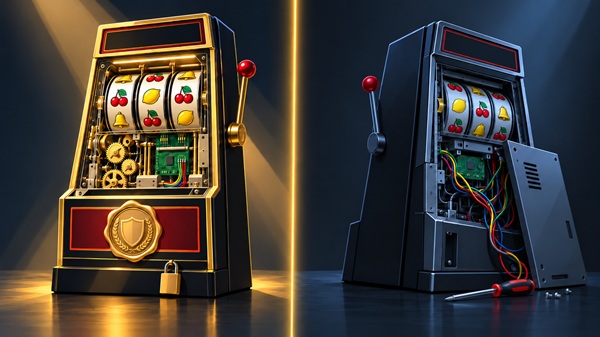
Everyone who’s ever watched a slot swallow twenty spins in a row with no return has thought it. The bonus that never comes, the win that lands the moment you drop your stake, the game that seems to know when your last win was. So let’s actually tackle it: what’s impossible, what’s legal but sly, and where the rigged machines are
By Brian Taylor | 9 September 2026
I’ve spent enough years around slots, playing them, reviewing them, studying the maths behind them, to have heard every version of the suspicion. “The game went cold the second I raised my stake.” “It paid out the day I joined and never again.” “It knows when I’m on a bonus.” Casino forums run on these convictions, and the industry’s stock replies about random number generators do nothing to dispel the rumours. So let me tell this story properly, because the truth of the matter has three layers, and each one is more interesting than you might imagine.
What happens when you press spin
I’ll start with the machinery, because almost every myth dies inside it. At the heart of every licensed slots game is a random number generator – a piece of code producing thousands of numbers a second, around the clock, whether anyone’s playing or not. The instant you press spin, the game grabs the number as it exists at that precise millisecond, and that number is the result. Everything that follows – the reels turning, the teasing slow-down, the symbol landing one position shy of the jackpot – is animation and theatre. The outcome was settled before the first reel appeared to move, which is why the stop button changes nothing except how quickly you see a decision that’s already been made.
That RNG doesn’t receive information about you. It isn’t told your balance, your stake history, whether you’re playing bonus funds or cash, whether you won yesterday, or whether you’ve just deposited. It can’t “tighten up” after your big win because it has no concept of your big win; it’s just a set of numbers with no memory and no audience awareness. The spooky pattern-sensing you experience happens only in your head, not in the code. It feels real because human brains are pattern-finding machines even when exposed to total randomness, and randomness is far streakier than your intuition expects. Twenty dead spins isn’t the game shafting you. It’s what random looks like, most of the time.
The wall around licensed games
Could a supplier or casino rig it anyway? Understand the architecture, and you’ll see why they don’t. The slot you play at a UK casino doesn’t live on that casino’s computers. It’s streamed from the game supplier’s servers, the same build serving hundreds of operators at once. Before it reaches any of them, it must pass through an approved independent test house that verifies the RNG and certifies the game’s return against the Commission’s technical standards, and the certified build is what runs. A casino can’t reach in and directly affect your session because the casino doesn’t hold the game. A supplier could theoretically corrupt its own product, but think about that. It would be a business whose entire value is its certification, risking everything to shave pennies off one game, in an environment where regulators dismantle companies for far less. Rigging a licensed slot isn’t just illegal. It’s commercially deranged.
The version of tampering that most people suspect – the operator watching your session and adjusting a dial to drain your bankroll – is not merely unlikely but structurally impossible on a licensed site. The dial doesn’t exist, the operator can’t reach the machine, and the machine can’t see you. Hold that thought, though, because a different kind of dial does exist, and it’s where your suspicion is justified.
The grains of truth in all the paranoia
The dial that does exist
Many slots are available in different certified versions with different returns, and the operator chooses which one you get. The same game can lawfully pay 96% on one site and 92% on another. That’s allowed under UK rules, but if you’ve ever sworn that a slot is tighter on one casino than another, you were probably right.
This is the piece of the puzzle that turns players into conspiracy theorists, because it validates the feeling while having nothing to do with per-session rigging. Configurable RTP means a supplier certifies a game at, say, 96%, 94% and 92%, and each casino picks its setting for its whole player base. Every version is tested, every version is random, and the percentage never changes mid-session or in response to you. But across casino sites, the same slot isn’t always the same deal, and the difference compounds fast over thousands of spins. The way to stay abreast of this is gloriously simple: the game’s info screen or paytable on the site you’re playing states the RTP of the version running there. Almost nobody reads it. Start being the player who does, and if your favourite slot displays a lower figure than you’ve seen elsewhere, you’ve just caught the only “rigging” a licensed site can do, done lawfully and in plain sight.
The second grain of truth is in the design. Slots are engineered, brilliantly and deliberately, to produce the sensations that feel like tampering. Near-misses, the jackpot symbol landing one row off, occur because reel strips are arranged to show you “almosts,” keeping the brain’s reward system active and interested. Celebrations fire for “wins” smaller than your stake, a fanfare for getting back 40p of your pound, which researchers call losses disguised as wins. None of this alters the certified odds; all of it affects how the odds feel, and the feeling is precisely “this thing is toying with me”. You’re not wrong that the game is built to manipulate. You’re wrong only about which layer the manipulation lives in: it’s in the presentation, engineered before certification, not in some casino boss’s control room. Even the honest games sit inside a profoundly dishonest theatre.
Quick verdicts on the classic myths
“Slots pay more at night.” False. The RNG has no clock. More players are online in the evening, so more wins happen and get seen, which is how the myth feeds itself.
“They pay new accounts, then tighten up.” False because the game doesn’t identify you. The seed of truth is that new players often start on bonus spins and low stakes, then up the ante, changing how the same variance feels.
“It knows I raised my stake.” False. Stake size doesn’t reach the RNG. Raising stakes does make losing streaks cost more, which is why they hurt enough to remember.
“A win is due after a cold run.” False, and dangerously so; this is the gambler’s fallacy. No spin owes anyone anything.
“The same slot plays better at another casino.” Genuinely true and legally permissible, via RTP versions. Check the paytable and make sure you’re using the best-configured version of the slot.
Where rigged slots might be found
Everything I’ve written above is true of the licensed side of the fence. On the other side of it, the answer to the question in this article’s title flips to an emphatic yes. Unlicensed black market casinos operate with no test houses, no technical standards, no certified builds, and no consequences, and the result is a market where cloned games flourish. You might struggle to spot them, too – they’re pixel-perfect copies of famous slots, the same branding wrapped around maths that favour the house, returns that can be set to whatever keeps the operator fed. Even a non-cloned slots game on an illegal site can’t be trusted since you’ve no way to confirm you’re playing the certified build rather than a doctored one. Investigations this year found real UK suppliers’ titles turning up on illegal sites through resale channels. On the licensed market, rigging is structurally impossible and economically insane. Off it, rigging is just a matter of opening the settings menu, and a player who suspects a game is cheating them has, for once, every reason to.
The suspicion players feel when they’re on a losing run is valid; it’s just aimed at the wrong target. Don’t question the spin, question the site: whose licence is on the footer? Can it be verified against the public register? Which RTP version of the game is confirmed in the paytable? Those checks catch everything catchable. If you find yourself truly convinced a game is punishing you personally, playing on to prove it or chasing the win the machine “owes” you are signs that it’s time to step back, use the limit tools, or talk to someone via the support links in the footer of this site. The game doesn’t hold grudges. Human minds do.
Can online slots be rigged, then? On a UK-licensed site, not in the way that prompted you to open this article: the game can’t see you, the casino can’t touch it, and the testing wall makes tampering a self-destruct button no supplier would press, though the legal tuning of RTP versions and the engineered near-misses give your instincts plenty of fuel. Off-licence, yes, straightforwardly, invisibly, and with no one to complain to afterwards. The unsatisfying truth underneath it all is that a licensed slot doesn’t need to cheat you, because the certified maths already collects its share with perfect patience. The house edge is the rigging, published, tested and legal, and the only move it can’t beat is reading the paytable, picking the better version, and knowing when the theatre has stopped being fun.