
Complaints
Do Casino Complaints in the UK Actually Go Anywhere?
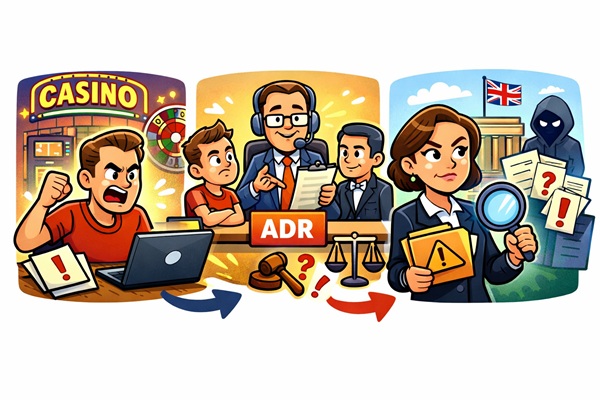
Players seem to ask this a lot at the moment. A withdrawal gets stuck. A bonus win disappears. An account is suddenly limited, locked, or subjected to a burst of forensic scrutiny that was nowhere to be seen before the wins started coming in. At that point, most people want a simple answer: who do I complain to, and is anybody actually going to do anything useful?
By Rob Hill
My short answer
Yes, complaints can go somewhere. But not in the way many players imagine. The UK system can produce results, especially when the facts are clear, and the paper trail is good. What it usually won’t do is give you a guardian angel who swoops in, reverses the casino’s decision, and gets your money back by teatime.
The mistake players make
They think “complaining to the Gambling Commission” means the Commission will adjudicate the dispute. It won’t. That is not its role.
The real test
A complaint has the best chance when you know which body should hear it, what the actual issue is, and what evidence proves your version of events.
I’ve been around this market long enough to know that players often bundle all grievances into one hopeless package. The casino withheld my withdrawal, spammed me after self-exclusion, asked for absurd documents, ignored my messages, and used a bonus term I never saw, therefore the regulator should sort it. I understand the instinct. It just doesn’t match how the system works.
The first thing to get straight is the route. In Britain, if your complaint is about the result of a gambling transaction or the service you received from a gambling business, you should complain to the business first. The Gambling Commission is explicit about that. It also states, very plainly, that it has no legal power to resolve individual complaints. That is the single most important sentence in this whole subject, because a lot of player frustration starts with expecting the wrong institution to do the wrong job.
The proper complaint route
Step 1
Complain directly to the casino or betting site and use its own complaints process first.
Step 2
If the complaint is unresolved after 8 weeks, or you get a deadlock letter, you may take it to ADR.
Step 3
If the issue is systemic, illegal, or regulatory, the Commission may still care, but not as your personal adjudicator.
The common complaint areas are what you’d expect them to be. The Commission’s own player guidance lists them clearly: whether you won, how much you were paid, how payments were managed, terms and conditions, bonus offers, ID verification, account closure, voided bets, IT issues, and customer service problems. In other words, most of the arguments players actually have are already recognised as normal complaint territory.
So yes, if your withdrawal has been delayed, if the site says your bonus win is void, if your account has been locked, or if a customer support officer has fed you contradictory explanations for a week, those are legitimate complaint subjects. Likewise, if you think a promotion was misleading, that you were paid the wrong amount, or that the casino used an unfair term after the event, you aren’t being melodramatic by complaining. Those are exactly the sorts of rows the system is meant to handle.
Where players go wrong is in expecting every unfair-feeling experience to be fixable through the same route. A dispute about your winnings is one thing. A data protection complaint is another. The Commission points people to the ICO for information on information rights issues, and it also notes that the gambling sector is one of the most complained-about sectors for unsolicited direct e-marketing. So if your real issue is misuse of personal data or spammy marketing, you may have a gambling angle, but the proper regulator for the data side is likely to be the ICO.
Likewise, if you’re unhappy with an ADR decision, the Commission is very clear that it cannot get involved with that decision or ask the ADR body to reconsider. At that point, the formal complaint route is usually over, and your next option, if you’re determined enough, is court. That’s not fun to think about, but it is the reality.
How “successful” are gambling complaints?
There is no single public market-wide success rate for UK gambling complaints. Different ADR bodies report outcomes differently. These figures are still useful as rough indicators, not perfect like-for-like comparisons.
Consumers receiving an ADR outcome to satisfaction, including settlements, concessions and upheld complaints.
Completed disputes ruled in favour of the consumer. eCOGRA’s methodology is different, so this is not directly equivalent to the IBAS figure.
Those numbers tell a useful story even with the caveats. Complaints absolutely can go somewhere, but they’re not a guaranteed player win machine. IBAS reported that 49% of consumers in 2023 to 2024 received an ADR outcome to satisfaction, while eCOGRA’s 2024 to 2025 report said 17.8% of completed domestic disputes were ruled in favour of the consumer, with 82.2% ruled for the operator. The methodologies are not the same, which is why I wouldn’t pretend the figures are directly comparable. But together they do tell you something sobering: good complaints can succeed, but plenty – most, in fact – do not.
There is another number I think matters even more. In eCOGRA’s 2024 to 2025 report, 500 disputes were invalid or discontinued, and 72.3% of those invalid disputes had not even been through the operator’s internal complaint procedure first. In the broader two-year eCOGRA report, the figure was 71.7%. That is a huge clue as to why many complaints “go nowhere”. They’re not always being rejected on the merits. Sometimes they fall over because the player has tried to jump the queue or use the wrong route too early.
What usually makes for a stronger complaint
A clear timeline.
Screenshots of the offer, rules, account balance and messages.
A precise explanation of what happened and what remedy you want.
Evidence that you actually followed the operator’s own complaints process first.
What weakens a complaint very quickly
Sending angry but vague messages instead of facts.
Changing the story as the dispute goes on.
Not knowing whether the issue is transactional, regulatory, or data-related.
Going to ADR before exhausting the operator process.
I also think players need to be realistic about what the regulator can do, even if it can’t resolve their individual dispute. The Commission says the Contact Centre data doesn’t provide a full picture of complaints, but it does provide an indication of the issues concerning customers and is used to help focus regulatory work. That means your complaint can still matter as intelligence, even when it doesn’t result in a personal payout for you. If ten operators are all playing the same game with withdrawals, identity checks, or murky terms, that’s exactly the sort of pattern the regulator should care about.
Withdrawals are a perfect example. The Commission has said its Contact Centre continues to receive around 2,000 complaints a year about delays to withdrawals, and the quarterly metrics page shows withdrawals and financial transactions as the largest complaint category in every quarter published for 2024 to 2025 and 2025. The regulator has also publicly criticised operators for happily accepting deposits and only investigating payment method concerns when a customer tries to withdraw. That tells me complaints about payment friction aren’t just player whining. They’re one of the clearest areas where a properly documented complaint can align with an existing regulatory concern.
The same is true of bonus disputes and account closures, though here players need to be more disciplined. “The bonus was unfair” is not enough. “The maximum bet rule was buried, the site accepted the wager anyway, and the operator only applied the term after I won” is much stronger. “The site asked for documents” is weak. “The site asked for documents it could reasonably have asked for earlier, then used the delay to hold up payment” is stronger. A complaint becomes much more persuasive the moment it stops sounding like an angry gripe and starts sounding like a case file.
This is also why I wouldn’t waste time complaining to the wrong body. If your issue is a standard transaction or service dispute, use the business first and then ADR. If it’s a data rights issue, think ICO. If it’s suspicious criminality or something larger, the Commission may want the intelligence. If you’re trying to overturn an ADR decision, understand that the Commission says that’s not its lane, and court may be the only remaining route. Different tools exist for different problems. Most failed complaints aren’t weak; they’re just badly aimed.
There is one final wrinkle worth knowing in the here and now. The complaints and disputes framework itself is in transition. The Commission says changes to Social Responsibility Code 6.1.1 are due to come into force on 6 April 2026, but they depend on when the Department for Business and Trade brings the relevant DMCC Act changes into effect. Under that new system, the Commission will no longer be the competent authority accrediting gambling ADR providers. That role shifts into a new accreditation framework under the Secretary of State, with transitional arrangements expected. For ordinary players, the immediate complaint route remains the same, but the plumbing behind ADR is changing, which is another reason this area feels more difficult than it should.
My verdict
Do casino complaints in the UK actually go anywhere? Yes, sometimes very definitely. But only when the player understands the route, frames the issue properly, and brings evidence rather than fury. The UK system can produce decent outcomes. What it cannot do is rescue every badly prepared complaint, and it certainly cannot turn the Gambling Commission into your personal claims handler. If I had to boil it down to one sentence, it would be this: complain early, complain clearly, complain to the right body, and don’t confuse regulatory interest with personal dispute resolution.