
Opinion | UK Online Casinos | March 2026
Is the UK Casino Scene Dying?

Short answer: It’s not terminal yet, no. But it’s coughing, shedding weight, and looking over its shoulder far more nervously than it was a year ago.
By Rob Hill
Bonus squeeze
Since 19 January 2026, UKGC rules have capped wagering at 10x and banned mixed-product bonus offers.
Tax hit
Remote Gaming Duty is due to rise from 21% to 40% from 1 April 2026.
Market shakeout
The public UK Gambling Commission register now shows large clusters of inactive domains under several white-label-heavy operators.
If you spend any time around the UK casino world – which I do, on a daily basis – you can feel the mood change. It’s there in the offers, which are cleaner but less juicy. It’s there in the sheer number of old brand names that have quietly shuffled off this digital coil. It’s there in the way the biggest operators issue statements – less like the conquerors of old, and more like concerned mathematicians. That doesn’t mean the UK casino scene is about to vanish in a puff of compliance paperwork. It does, however, mean the easy-growth version of it that’s been around for the past decade looks like it’s over.
My own view is that the scene isn’t dying in the dramatic sense. It isn’t heading for some theatrical collapse where every other site goes dark, and the surviving ones play a mournful violin in tribute. What is happening is actually harsher and, in some ways, more interesting. The market is being compressed. The flimsier brands are being squeezed. The old white-label sprawl is looking less sustainable. And the operators with real scale are quietly positioning themselves to survive a storm that smaller businesses might not get through.
The bonus era has clearly changed
The January 2026 bonus changes were not trivial tweaks. The Gambling Commission’s revised social responsibility rules now ban mixed-product promotions and cap wagering requirements at 10x. From a player-protection point of view, that’s sensible enough. The old “bet on sports, unlock casino spins, now read seventeen footnotes and re-stake your soul” style of offer deserved a proper burial. But let’s not pretend there’s no commercial cost. A huge amount of UK acquisition marketing relied on over-dressed bonus pages and enough small print to sink a fishing boat.
Once you strip out that style of promotion, weaker operators lose one of their easiest ways to fake value. They can no longer dress up a middling site with a headline figure and hope the terms do the rest. The market becomes flatter, which is good for clarity but bad for brands that had little else to sell. That doesn’t kill a healthy operator. It does expose a lazy one, though.
The tax picture is worse than many people realise
Then there’s the tax shock. This is the bit that really changes the weather. HM Treasury has confirmed that Remote Gaming Duty will rise from 21% to 40% from 1 April 2026. It has also set out a new 25% remote betting rate from April 2027, while saying the wider package is expected to raise more than £1 billion a year. Again, these aren’t small adjustments to the status quo. This is a heavy state hand reaching directly into a business model that was already becoming more regulated, more monitored, and more expensive to run, and crying to pull that hand back out, clutching even more money.
The people who shrug this off as nothing more than a rich-industry inconvenience are kidding themselves a bit. Big operators may survive it, but even they’re feeling the pinch. Reuters reported this month that Entain expects about £200 million in additional annual costs from the UK tax changes. The same reporting also noted that the company believes the pain will hit smaller rivals harder, which is probably true. Large groups can trim, automate, consolidate, and absorb. A middling casino brand with no real reserves usually can’t.
In 2026, the UK casino market isn’t being killed by one thing. It’s being squeezed from both sides: By stricter consumer rules on one side and much heavier taxation on the other.
The white-label thinning is impossible to ignore
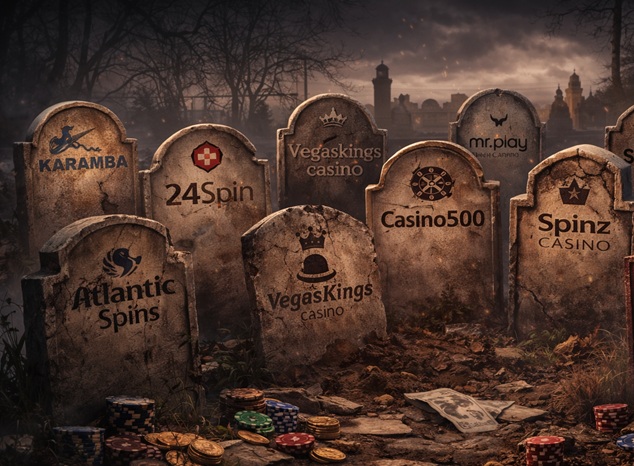
This is the bit that players can actually see, if they know where to look. The Gambling Commission register has become a kind of graveyard map. AG Communications, account 39483, currently shows 81 domains, but a huge block of them are marked inactive, including formerly well-known brands such as 24spin, Atlantic Spins, Karamba, Mr Play, PlayClub and WildSlots. Grace Media, account 57869, looks even more brutal at first glance: 74 domains listed, yet only Hot Streak Casino and Royal Valley Casino show as directly active, with names such as 444 Casino, Casino 500, Magma Casino, Planet Rock Casino, Spinz Casino and Vegas Kings Casino no longer trading. Skill On Net’s register entry shows 61 domains, including inactive names such as Megaways Casino and Winning Kings. Jumpman’s entry is larger still at 235 domains, with inactive listings including Atlantis Wins, Dream Bingo, OnlineBingo.com, Pretty Wins, Royal Spins, Slots Gold and many more.
Now, to be fair, an inactive domain on the register is not always proof that a closure happened yesterday. Some brands died earlier. Some may have been dormant. Some may have migrated, merged, or simply fallen off the strategy board. In this case, though, we’re talking about brands that have vanished within the past two or three months. This isn’t one or two sites disappearing in the ordinary churn of online gambling. It’s a visible contraction in the parts of the market that once seemed able to support endless near-identical brands.
AG Communications is the sharpest example because there is actual reporting around it in other industry press. In late January, iGB Affiliate reported that Aristocrat Interactive-owned Aspire Global had partially shut down its UK white-label casino operations, and later confirmed to iGBA that it would close its entire white-label operation by June 2026. Yes, the whole stable. The loss of AG Communications from the UK marketplace would have been unthinkable this time last year, and yet here we are.
So is this decline, or just a cleanup?
That depends on what you think the UK casino scene really is. If you think it means the total amount of gambling activity, then no, the market is not dying in any simple sense. The largest operators are still large. The biggest platforms are still launching products, buying technology, and talking about efficiency rather than surrender. The market may well end up more concentrated, but concentration is not the same thing as death. It’s hard to argue against the fact that it’s declining, though – and we’re going to lose even more well-known names before the year’s out. Farewell, Mr Play. Cheerio, Spin Rio. It’s been fun.