
The Sister Site
The Sister Site is an information source for casino players across the UK. We know you want to find out which casinos share the same parent company, who pays, who doesn’t, how licensing works, and much more, so we’ve created guides, information pieces and research papers to give you the answers to those questions. Here, you’ll easily find detailed guides to casino banking protocols, how casino networks work, who has the best RTP, and even the role AI is beginning to play in the UK casino scene.
Trying to track down the true owner of a casino or the network it sits on can be difficult. You can spend days combing through licensing registers trying to connect two sites – never mind dozens of them. Thankfully, we’ve done the hard work for you. Our indexes are up to date, our network information is always up-to-the-moment, and new guides and content are added regularly.
Every single guide, review and research paper is written by a casino expert who truly knows the industry inside out. We understand the software platforms, and have an intimate knowledge of the relationships between different brands, networks, and providers. It’s genuine, personal casino advice from people who actually play.
Latest UK Casino News and Information
Robin Hood Bingo Sister Sites: Broadway’s Band of 86 Sites
Robin Hood Bingo is one of 86 sites Broadway Gaming runs on one UK licence, and its sister sites range from a London bus to an Irish meadow. Meet the band.
Skol Casino Sister Sites: Inside White Hat’s Top Brands
Skol Casino is one of seven brands White Hat Gaming runs under its own steam, and six of them share one welcome offer. Get to know the top sister sites here.
Booming Slots Sister Sites: The Foxx Family Grows to Eleven
Booming Slots has ten sister sites on its platform, and one offers the exact same welcome package. Find out which, and what’s known about the rest, here.
Bloody Slots Sister Sites: The Casino’s Blood Ties
Bloody Slots dresses up as a London casino, but its family of five sister sites shares one secretive owner and holds no UK licence. See how they compare.
JawBets Sister Sites: Five Foxxy Casinos Sharing a Rulebook
JawBets doesn’t directly name its owner, but its sister sites all share its rulebook, and the paperwork points to Foxx Entertainment. Meet the family here.
Moon Bingo Sister Sites: A Galaxy of 86 Broadway Bingo Sites
Moon Bingo has exactly eighty-six sister sites on the Broadway Gaming licence, and at least one copies its terms to the letter. Meet the full family here.
Pike Casino Sister Sites: Goodwin’s Five Curaçao Casinos
Pike Casino doesn’t name its owner, but three of its sister sites do: Goodwin N.V. of Curaçao. Meet the Pike Casino sister sites and see how they compare.
Bingo Diamond Sister Sites: The Broadway Gaming Ten
Bingo Diamond was the last bingo site Broadway Gaming bought before its big 888 deal. Come and see its sister sites, from Glossy Bingo to Casino Fantastico.



Do You Pay Tax on Online Casino Winnings in the UK?
Online casino winnings are normally tax-free in the UK, regardless of size. Here’s when HMRC, benefits or investment taxes may still matter.

Why Won’t My Casino Let Me Withdraw to a Different Payment Method?
Your casino says you can’t withdraw to a different payment method. That can be both annoying and very inconvenient. Here’s why that happens, what’s fair, and what to ask next.

Do UK Casino Affordability Checks Look at Your Bank Balance?
The automated checks don’t see your bank balance, and one isn’t even live yet. Here’s what’s real, what’s only proposed, and what actually asks to see your account.

Will Your Gambling Show Up on a Mortgage Application?
Gambling never lands on your credit score, but the bank statements lenders ask for tell the full story. Here’s what underwriters really see, and the window that matters most.

How Long Can a UK Casino Legally Hold Your Withdrawal?
Your balance says you’ve won, but the payout sits “pending” for days. There’s no single legal deadline, so here’s the rule that actually decides when a hold crosses the line.

Can Your Bank Block Gambling Payments, and Can You Undo It?
Your bank’s gambling block stops casino payments in seconds, but switching it off takes days. What does it really catch, and what slips through the gaps?

A Casino Took My Deposit But Didn’t Credit My Account. What Now?
A casino deposit left your bank but never appeared in your balance? That’s a problem. Here’s what to check, what to ask support, when to complain, and who to.
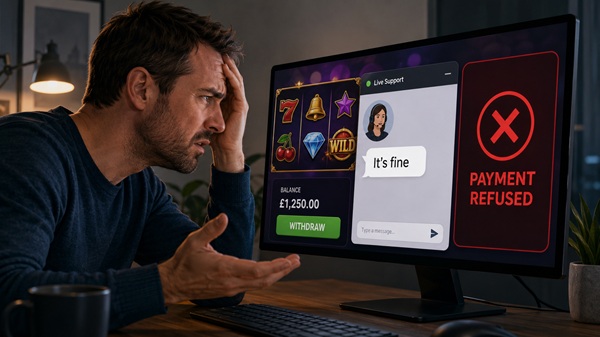
Casino Support Told Me It Was Fine. Can They Still Refuse to Pay?
Casino support said your play was fine, but the operator later refused to pay. Here’s when the chat evidence matters, and when the terms may still win.
Is Your Casino Lobby Nudging You Towards the Wrong Games?
Casino lobbies look neutral, but they decide what you see first. Here’s how UK players are nudged before they even spin.
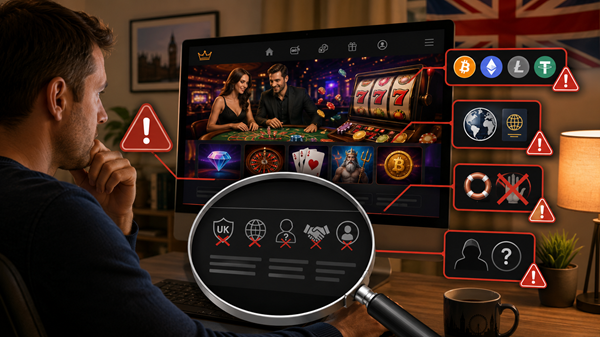
How Do You Know If You’re Playing At A Black Market Casino?
Black market casinos don’t tell UK players they’re unsafe. Here’s how to spot the on-site warning signs before you deposit.
Trusted UK Safer Gambling Support
We only recommend casinos and betting sites that take safer gambling seriously. These are some of the most important names in the UK when it comes to regulation, self-exclusion, support, and practical help.
UK Gambling Commission

The UKGC is the regulator for commercial gambling in Great Britain. It sets the rules licensed operators must follow and provides public guidance for players.
Phone: 0121 230 6666
Website: gamblingcommission.gov.uk
GamCare

GamCare operates the National Gambling Helpline and offers free, confidential advice, support, and treatment information for anyone affected by gambling harm.
Helpline: 0808 8020 133
Website: gamcare.org.uk
GAMSTOP

GAMSTOP is the UK’s national online self-exclusion scheme. Registering with GAMSTOP blocks access to participating gambling websites and apps licensed in the United Kingdom.
Phone: 0800 138 6518
Email: helpdesk@gamstop.co.uk
Website: gamstop.co.uk
GambleAware

GambleAware provides safer gambling advice, self-help tools, and routes into treatment and support through the National Gambling Support Network.
Support line: 0808 8020 133
Website: begambleaware.org
NHS Gambling Support

The NHS provides specialist gambling treatment clinics and signposts support for people whose gambling is affecting their finances, relationships, or mental health.
Access: Self-referral or via your GP
Website: nhs.uk
Samaritans

If gambling is affecting your mental health and you need someone to talk to right now, Samaritans offers free, confidential emotional support 24 hours a day.
Phone: 116 123
Website: samaritans.org


PlayOJO: why this big brand is a refreshing change
Lots of casinos claim they’re fair and transparent, then bury anti-player terms in the small print. PlayOJO’s big selling point is that it keeps things simple: you’re not chasing a bonus through endless hoops just to unlock your own cash. It’s a calmer, cleaner experience, especially if you just want a proper session without the constant feeling that the site’s trying to upsell you.
- No wagering requirements as the core message; wins don’t come with the usual “meet X first” conditions. Even though an x10 wagering requirement is considered the maximum allowed since the UK Gambling Commission updated its rules in January 2026, PlayOJO completely bypasses this by offering zero wagering.
- Less clutter, more play; the whole thing feels more like “pick a game and crack on” than a marketing funnel.
- Good fit for casual players who want fairness and speed over complicated bonus mechanics.
- Worth knowing: if you live for huge bonus ladders and promos, it can feel a bit restrained.
Licensing Details
Operated under the strict regulations of the UK Gambling Commission under license number 39326, held by Skill on Net Limited. Account funds are protected, and games are independently audited for fairness.

What Do The January 2026 UKGC Rule Changes Mean For Players?
The January 2026 rule changes are mostly about one thing: making casino bonuses and promotions less confusing, less manipulative, and a bit harder to dress up as a bargain when they aren't.
In Brief
Gambling regulation often arrives wrapped in language that makes ordinary people's eyes glaze over. Licence conditions, code provisions, consultation papers, implementation dates. It can all feel a bit like reading the terms on a TV warranty. But the January 2026 UK Gambling Commission changes are actually pretty easy to understand once you get past the official phrasing. They're mainly about promotions, and more specifically about stopping operators from making those promotions more complicated and more risky than they need to be.
That matters because bonuses are one of the main ways online casinos attract players. They are also one of the easiest ways to mislead them. Not always in some wild, criminal sense. More often in the perfectly legal but deeply irritating sense, where an offer looks generous in the headline and turns out to be impossible to turn into cash once you read the conditions properly. The new rules are meant to end that practice.
The real story here is not that bonuses are disappearing, but that the UKGC wants them to be harder to disguise as something better than they really are.
The end of mixed-product bonus offers
One of the clearest changes is the ban on mixed-product promotions. In plain English, that means an operator should no longer be able to offer you a deal that pushes or requires you to bounce between different kinds of gambling to get the full value. The classic example would be a sign-up package that involves a sports free bet plus casino spins, or a reward structure that only makes sense if you drift from one product vertical into another.
For players, this is more important than it may sound. The gambling industry loves a bundle when it suits them. Bundle this, cross-sell that, try a little of everything. From the operator's point of view, it's a neat way to move a customer around the site and deepen engagement. From the player's point of view, it often creates confusion. You signed up for one thing, and suddenly you're being ushered into three others with a trail of conditions behind you.
The new rule cuts through that. It should mean fewer offers designed to drag players into unfamiliar products just because the promotion has been stitched together that way. If you want a casino bonus, you should be getting a casino bonus, not a small obstacle course disguised as one.
The 10x cap on wagering requirements
This is probably the change players will care about most, because it goes straight to the heart of what makes a bonus worthwhile, or worthless. Wagering requirements tell you how many times bonus funds, or winnings from those funds, have to be staked before you can withdraw. Operators have long used high wagering requirements to make offers look better than they are. The headline says free money. The terms quietly say good luck ever seeing it.
From 19 January 2026, those requirements became capped at 10x. That doesn't mean every bonus is suddenly brilliant, because a poor promotion can still be dressed up in other ways. Game restrictions, max cashout clauses, expiry windows, and payment exclusions can still make a mess of things. But a 10x cap is a meaningful improvement all the same. It narrows the gap between what the banner promises and what the player can realistically expect.
More than that, it restores a bit of proportion. A bonus should feel like an incentive, not something you're obliged to grind out until it turns into something worthwhile. If an offer needs endless re-staking just to release real money, it stops being a perk and starts being a trap disguised with glitter and sparkles.
What should actually improve for players?
The first improvement should be clarity. There ought to be fewer promotions that make sense only after ten minutes of squinting at the terms and conditions. That alone is helpful. Most players are not compliance specialists. They are trying to work out whether an offer is decent, not whether they need a legal translator.
The second improvement is comparability. If operators are working within tighter boundaries, it becomes easier to compare offers on something closer to a level playing field. You are less likely to have one site screaming about a huge package that is, on inspection, tangled up in ridiculous playthrough demands. That does not make every brand honest, but it does make it harder for the most aggressive offers to get away with murder via typography.
The third is behavioural. The Commission's logic here is that complex or mixed promotions can encourage players to gamble for longer, gamble across more products, or gamble in ways they did not set out to. Whether every player feels that risk in the same way is another question, but the broad point is hard to argue with. Complexity in gambling nearly always favours the house.
When a promotion becomes difficult to explain in one clean sentence, that's the moment a player should become suspicious.
What won't change overnight
It would be a mistake to imagine that January 2026 suddenly turned every UK casino into a model of saintly transparency. Operators will still compete hard for attention. They will still phrase offers in the most flattering possible way. They will still lean on urgency, bright design, and selective emphasis. The difference is that they now have less room to build promotions around the sort of mechanics that tend to confuse players or drag them into more gambling than they bargained for.
Players should also remember that a legal bonus is not automatically a good bonus. A 10x wagering cap is better than 40x or 50x, clearly enough, but that doesn't make every promotion worth taking. Sometimes the smartest move is still the unfashionable one, which is to ignore the bonus entirely and play with cash on straightforward terms.
Why this matters beyond bonuses
These changes are about more than the shape of a welcome offer. They tell us something about the direction of travel in UK regulation. The Commission is signalling, quite firmly, that if a promotion encourages confusion, intensity, or cross-product drifting, it is no longer prepared to shrug and call that marketing. That is a meaningful shift in tone.
For players, the wider lesson is that the UK market is continuing to move towards simpler presentation, more visible control tools, and less tolerance for gimmicks that rely on people not fully understanding what they have clicked on. That won't please every operator, and it won't magically fix every complaint players have about online casinos, but it is broadly good news for anyone who prefers gambling offers to be readable by humans rather than decoded like wartime telegrams.
So what should players do now?
First, expect bonus offers to look a bit plainer. That is not a downgrade, even if some casinos try to spin it that way. In many cases, it means the decoration has been stripped off and you can finally see the deal more clearly.
Second, keep reading the terms. The new rules close off some of the more annoying tricks, but they do not abolish bad value. Look at expiry periods, game weighting, max bet limits, and any cashout cap before you decide an offer is worth your time.
Third, take the broader hint. If an operator is still making an offer feel needlessly tangled, even under tighter rules, that tells you something about the brand. Good casinos do not need smoke and mirrors to sell themselves.
In the end, the January 2026 changes mean exactly what sensible regulation ought to mean for players. Less clutter. Less cross-selling disguised as generosity. Fewer absurd wagering hurdles. More chance of knowing what you are actually agreeing to. Not glamorous, perhaps, but useful. And in gambling, useful usually beats flashy.
Quick Questions
What is the biggest January 2026 change for players?
The biggest practical change is that bonus offers are now more restricted, especially where mixed-product promotions and high wagering requirements are concerned.
Are casino bonuses banned in the UK now?
No. Bonuses are still allowed, but the rules around how they are structured are tighter.
Does a 10x wagering cap mean every bonus is worth taking?
No. It improves the position for players, but other terms can still make a promotion poor value.